
Can You Upgrade a Laptop
Yes, many laptops’ components can be upgraded to improve performance or increase storage. The most common and cost-effective upgrades are memory (RAM) and hard drive (SSD/HDD).
Further Reading: Is It Worth Upgrading a Laptop
If your laptop is less than 5 years old and only needs a specific boost, like more memory or storage, upgrading is generally worth it. After the upgrade, your laptop’s performance can improve significantly.
However, if you encounter performance issues due to the CPU or GPU, which are soldered to the motherboard, it is recommended that you buy a new laptop. Additionally, if the upgrade would exceed 50% of its value, buying a new laptop may be a better choice.
Commonly Upgradable Laptop Components
Upgrading a laptop can boost its performance and prolong its lifespan.
However, compared to desktops, laptops are more restricted, usually with only specific components upgradeable.
Below are the most commonly upgradable laptop parts.
Storage Drive
Storage drives are essential for holding the operating system, applications, and files on a laptop. Most laptops nowadays allow for storage upgrades.
The common types of laptop storage include M.2 NVMe SSDs and 2.5-inch SATA SSDs or HDDs. M.2 NVMe SSDs are the fastest and the most prevalent options today, while 2.5-inch SATA SSDs and HDDs are often found in older laptops.
Typical upgrade steps include:
- Replacing a 2.5-inch HDD with a 2.5-inch SATA SSD.
- Swapping or adding a larger M.2 SATA or M.2 NVMe SSD.
Upgrading your storage drive can significantly improve boot and load times, and it also provides additional storage space.
RAM
RAM (Random Access Memory) is a type of volatile memory used for temporary data storage. It allows for fast read and write access for active applications. Unlike HDDs or SSDs, it loses all its data when the power is turned off.
Many laptops have one or two SO-DIMM (Small Outline Dual In-line Memory Module) slots that are typically accessible after removing the bottom panel. However, some modern thin laptops come with soldered RAM, which cannot be upgraded.
Upgrading RAM is one of the easiest and most impactful methods to improve the PC performance, involving:
- Faster multitasking and overall responsiveness
- Smoother performance when using multiple browser tabs or applications
- Better performance in creative software and some games
Wi-Fi Card
The Wi-Fi card manages both wireless internet and Bluetooth connectivity. It is typically replaceable through an M.2 or mini-PCIe slot. Here are the benefits of upgrading the Wi-Fi card:
- Support for newer wireless standards, such as Wi-Fi 6, Wi-Fi 6E, or Wi-Fi 7
- Enhanced connection speeds
- Improved Bluetooth technology
Battery
Laptop battery degrades over time, and upgrading it can improve battery life.
Upgrading a laptop battery means replacing an aging, degraded battery with a higher-capacity one to prevent shutdowns, ensure stable power, and enable higher processor speeds, especially on gaming laptops.
Older models often have external batteries, while newer ones typically use internal battery packs that can still be replaced using basic tools.
You should consider upgrading the battery if you notice any of the following signs:
- The battery drains quickly.
- The laptop shuts down unexpectedly.
- There are charging issues.
- The battery area becomes excessively hot frequently.
- The battery comes up with physical swelling.
- The laptop only works when plugged in.
- The “Service Battery” Warning shows up on your screen.
- The battery percentage jumps around.
Cooling System (Fans/Thermal Paste)
The whole cooling system of a laptop includes fans and thermal paste. They are very useful to dissipate heat. Upgrading them can bring these benefits:
- Reduce heat
- Improve sustained performance
- Quieter operation
Upgrading the fan and thermal paste is also one of the common laptop maintenance tasks. Additionally, you can clean the dust in the laptop’s interior when you perform the cooling system upgrade.
Commonly Non-Upgradeable Laptop Components
Not all components of a laptop can be upgraded. Some components are soldered to the motherboard or are tightly integrated, especially in thin-and-light models.
If these components fail or become outdated, it may be necessary to replace the entire motherboard or even the whole laptop.
Here are commonly non‑upgradeable components.
CPU
Most modern laptop CPUs utilize BGA (Ball Grid Array) packaging, meaning they are soldered directly onto the motherboard.
This design implies that you cannot swap the CPU just like in desktop PCs. To upgrade the CPU, it is necessary to replace the entire motherboard, which is often too expensive.
GPU
Unlike desktop graphics cards, laptop GPUs are typically integrated into the motherboard or CPU.
As a result, you cannot replace the GPU with a more powerful one.
Display
Display upgrades are limited because displays must match many aspects, including the connector type, resolution support, and mounting brackets. The monitor is only replaced when it breaks down.
Motherboard
The motherboard is the main component of the laptop, integrating the CPU, GPU, power circuits, and ports. While it is technically possible to replace it, doing so is very expensive, difficult to find a matched motherboard, and often incompatible with other parts.
Furthermore, replacing the motherboard costs nearly as much as buying a new laptop.

How to Check if Your Laptop Is Upgradeable
Before the laptop upgrade for optimal performance, it is necessary to check if the laptop is upgradeable.
For this, check the PC specifications, hardware design, and internal layout of your laptop.
Here are the most practical methods to determine if your laptop supports upgrades.
1. Identify your laptop model.
- Check for a sticker on the bottom of the laptop or under the battery.
- View the current RAM and disk types in Task Manager. (Open Task Manager > Performance > Memory.)
- See the System Model in System Information. (Open Run, type msinfo32, press Enter to open System Information, and find System Model from the list.)
2. Check the laptop specifications.
Go to the manufacturer’s website or check the product manual to find out the laptop’s specifications. Pay attention to Memory, Storage, and Maximum supported capacity.
3. Look up teardown or upgrade guides on the Internet.
Here are some reliable sources:
- YouTube teardown videos
- Tech review websites
4. Open the laptop to check inside (if possible).
Here are the steps:
- Power off the laptop and unplug it.
- Remove the bottom screws and then remove the cover.
- Look for visible RAM slots or storage drives. If you see accessible components, the laptop is likely upgradeable.
5. Identify compatibility.
Checking the upgrade compatibility is also very important. Here are some methods:
- Official Websites: Search your model on the brand’s support page for the “Specifications” or “Manual” section.
- Manufacturer Tools: Use Crucial Advisor or Kingston Configurator for instant compatibility lists.
- Community Guides: Search YouTube or Reddit for “[Model] + upgrade” to see real teardowns and results.
How to Upgrade a Laptop Safely
To safely upgrade your laptop, start by grabbing compatible parts and the right tools. Then, follow the instructions to upgrade your hard drive, RAM, Wi-Fi card, battery, and cooling system.
Here’s the detailed breakdown:
Preparation
Before starting the laptop upgrade, purchase the compatible components first from an online or offline store, such as the SSD, RAM, Wi-Fi card, and others.
Additionally, using the proper tools reduces the risk of damaging internal components. Basic tools usually include:
- Precision screwdriver set
- Plastic pry tool or spudger
- Anti-static wrist strap
- Small container for screws
Laptop Storage Upgrade
To upgrade your hard drive, the whole process can be divided into three phases:
- Clone data from the old disk to the new SSD
- Replace the old disk with the new SSD
- Boot from the new SSD and test the laptop
Phase 1. Clone data from the original disk to the new SSD
For this task, MiniTool ShadowMaker is a reliable option. It is not only PC backup software but also a disk cloning tool. It provides a Clone Disk feature that allows you to clone an HDD to an SSD or clone SSD to larger SSD easily.
Here’s how to use it to clone the system drive to a new SSD:
Step 1. Connect the new SSD or larger SSD to your computer via a USB to SATA cable or an adapter based on your situation.
Step 2. Download and install MiniTool ShadowMaker on your laptop.
MiniTool ShadowMaker TrialClick to Download100%Clean & Safe
Step 3. Launch this software and enter the License Key to upgrade to Pro or higher edition.
Step 4. Select Tools and click Clone Disk.
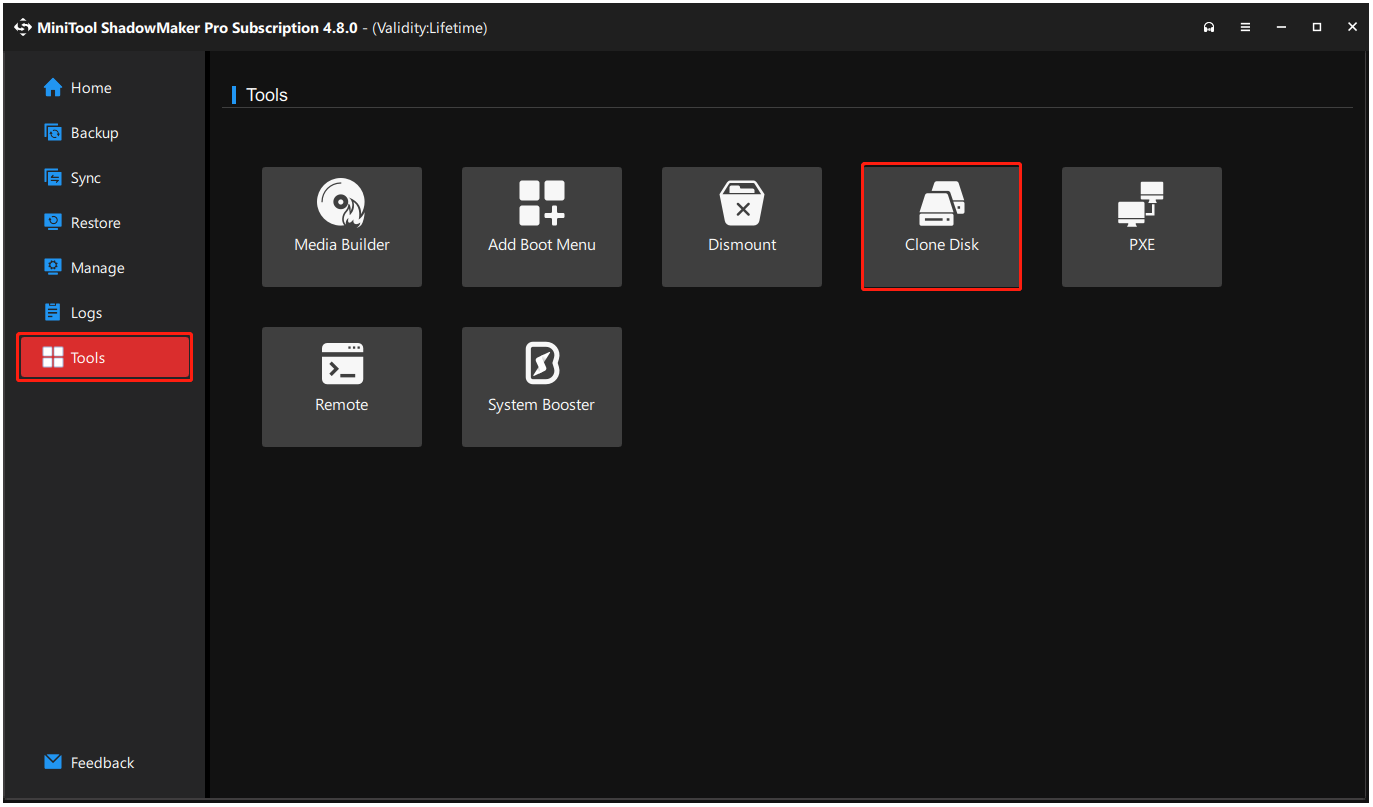
Step 5. Select the original disk from the list and click Next.
Step 6. Select the target SSD from the list and click Start. When the Warning dialog pops up, click OK to proceed.
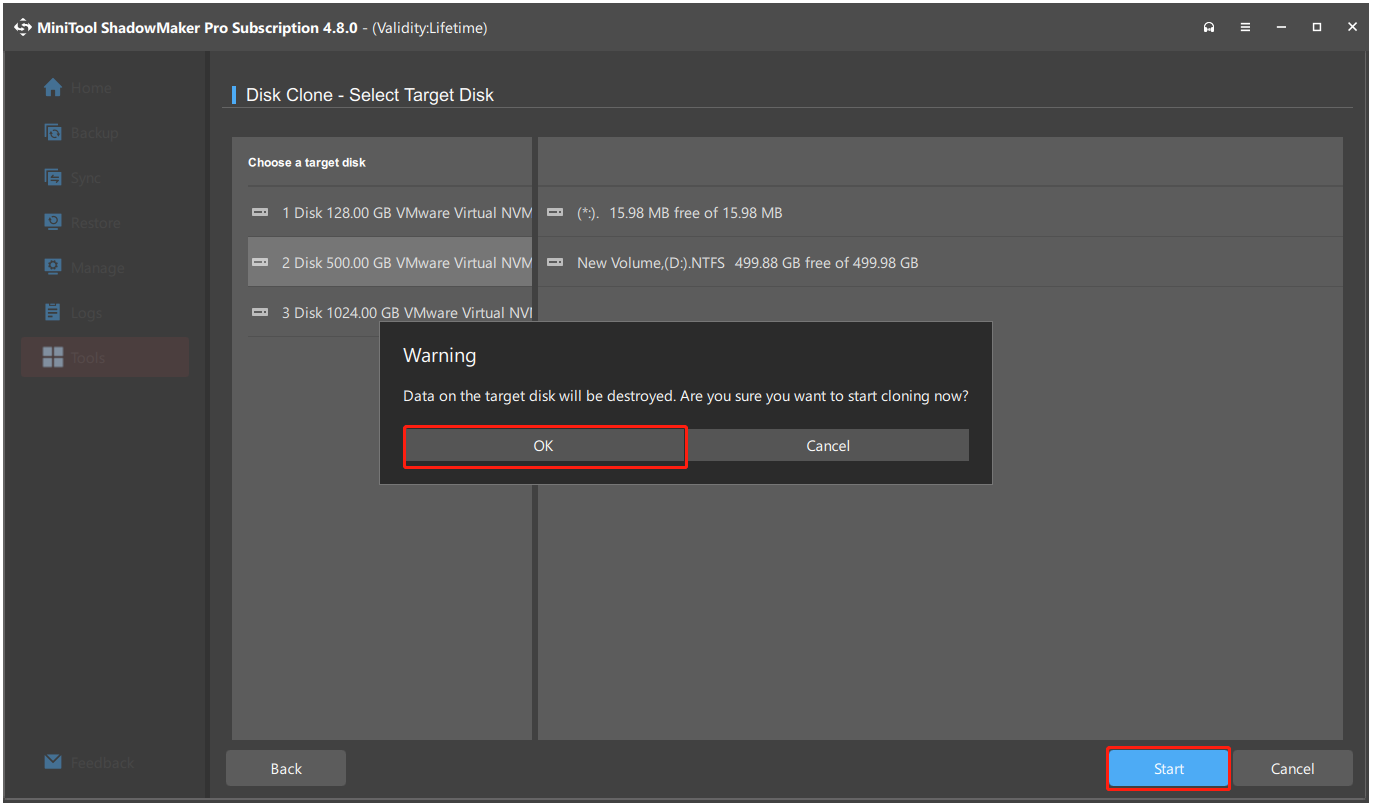
Step 7. Now, the cloning process will start. Once done, click Finish.
Phase 2. Replace the old drive with the new SSD
Step 1. Turn off the laptop, unplug it, and ground yourself to avoid electrostatic discharge.
Step 2. Remove the bottom screws and use a pry tool to remove the cover.
Step 3. Disconnect the battery connector to prevent short circuits.
Step 4. Replace/add drive.
- Single-slot: Unscrew the old SSD/HDD, move it out, install the new SSD, and then secure it with the screws.
- Dual-slot: Insert the new SSD into the empty slot.
Step 5. Reconnect the battery and replace the cover.
Phase 3. Boot from the new SSD and test the laptop
Once you’ve reassembled the laptop, do the following steps:
Step 1. Power on the laptop.
Step 2. Boot into the BIOS menu. Change the boot order and set it to boot from the new SSD.
Step 3. After loading Windows, open Task Manager, and go to Performance to check the new storage drive.
Now, you’ve finished a laptop SSD upgrade successfully.
Laptop Memory Upgrade
Here you can learn how to upgrade RAM on a laptop.
Step 1. Power off the laptop completely.
Step 2. Open the laptop back cover and disconnect the battery connector.
Step 3. Find RAM on the motherboard, remove the old RAM, and then install the new RAM.
Step 4. Reconnect the battery, close the back cover, and turn on the laptop. Now, you’ve completed a RAM upgrade successfully.
Laptop Wi-Fi Card Upgrade
Here’s how to perform the laptop Wi-Fi card upgrade:
Step 1. Open the laptop and disconnect the battery.
Step 2. Locate and remove the old Wi-Fi card. Then, detach antenna connectors carefully.
Step 3. Install the new Wi-Fi card and reattach antenna cables.
Step 4. Reassemble and verify it.
Laptop Battery Upgrade
To upgrade your laptop battery, first buy a compatible higher-capacity battery by verifying your model number. Power off the laptop, open the case, and carefully disconnect and remove the old battery. Drop in the new one, reconnect the cable, and reassemble.
Just double-check whether the battery is installed properly, as some higher-wattage batteries are physically larger than the originals.
Laptop Fans/Thermal Paste Upgrade
To upgrade your laptop’s cooling, open the case and remove the heatsink. Then, use 70%+ isopropyl alcohol and a lint-free cloth to clean the old thermal paste from the CPU and GPU.
Next, apply a pea-sized drop of new thermal paste. Additionally, use compressed air to clean dust from the fans. After that, reassemble the laptop.

Bottom Line
This post answers the question of whether you can upgrade your laptop, lists common upgradable laptop components & non-upgradable laptop components, and explains how to do that.
When you upgrade the laptop storage drive, MiniTool ShadowMaker can help you clone data from HDD to SSD or a smaller SSD to a larger one.
What’s more, if you encounter issues while using this MiniTool ShadowMaker, feel free to contact us by sending an email to [email protected].
Can You Upgrade a Laptop FAQ
Lenovo ThinkPad E-series and P-series are also good options, offering upgradeable RAM and storage, though they are less modular than Framework laptops.
Next, update your OS and drivers, then uninstall any pre-installed bloatware. This cleans up the system and ensures your software is running at peak performance.
About The Author

Position: Columnist
Charlotte is a technology columnist with a strong focus on the Windows operating system, specializing in disk management, backup, and data recovery. She is passionate about analyzing computer errors, identifying root causes, and delivering practical solutions. In her free time, she stays updated on the latest developments in computer systems and hardware while continuously learning new technologies to broaden her expertise. Her writing style is clear and easy to understand, making complex technical topics accessible even to users with limited computer knowledge.
User Comments :