
The ntoskrnl.exe BSOD error is often caused by driver issues, corrupted system files, memory problems, or hardware failures. This MiniTool guide outlines some methods to resolve the error, such as running SFC & DISM, updating drivers, and uninstalling Windows updates.
Quick Answer
If you see a “What failed: ntoskrnl.exe” blue screen on Windows 11/10, it usually indicates problems with drivers, system files, memory, or hardware.
Ntoskrnl.exe is a core Windows system file, and the error is typically caused by other faulty components rather than the file itself.
Fixes include running SFC/DISM, updating drivers, checking disk and RAM, removing recent updates, or using System Restore.
What Is Ntoskrnl.exe & Ntoskrnl.exe Blue Screen
Ntoskrnl.exe (Windows NT operating system kernel executable) is a core Windows file responsible for essential functions such as memory management, process management, and hardware abstraction.
The file itself is safe and required for Windows to run. However, when drivers, system files, memory, or hardware fail, Windows may crash and display an ntoskrnl.exe BSOD error. The ntoskrnl.exe BSOD screen displays the following message:
“Stop code: IRQL_NOT_LESS_OR_EQUAL
What failed: ntoskrnl.exe”

Causes of BSOD Ntoskrnl.exe
The ntoskrnl.exe BSOD error is usually not caused by the ntoskrnl.exe file itself. Instead, it often occurs when drivers, system files, memory, or hardware problems interrupt Windows kernel operations. The common causes include:
| Cause | Description |
| Corrupted system files | Damaged Windows components may cause kernel crashes. |
| Driver issues | Outdated or incompatible drivers can conflict with Windows. |
| Memory problems | Faulty RAM can trigger unexpected system crashes. |
| Windows updates | Buggy updates may cause compatibility issues. |
| Hardware failures | SSD, HDD, or motherboard problems can lead to BSOD. |
Protect Your Data Before Troubleshooting BSOD
Before trying advanced troubleshooting steps, it is recommended to protect important files first. Some solutions, such as resetting Windows, updating BIOS, or replacing hardware, may involve certain risks.
If Windows can still start, you can manually copy important files to another drive. If frequent BSOD crashes prevent normal access, a bootable backup tool can help create a backup before repairing the system.
For that, MiniTool ShadowMaker deserves to be recommended as it can help create system backups and bootable media when Windows cannot start normally.
Check how to back up data:
Step 1: Create a bootable USB drive on a working computer.
1. Download, install, and launch MiniTool ShadowMaker.
MiniTool ShadowMaker TrialClick to Download100%Clean & Safe
2. Register this software. Then, head to Tools and hit Media Builder.
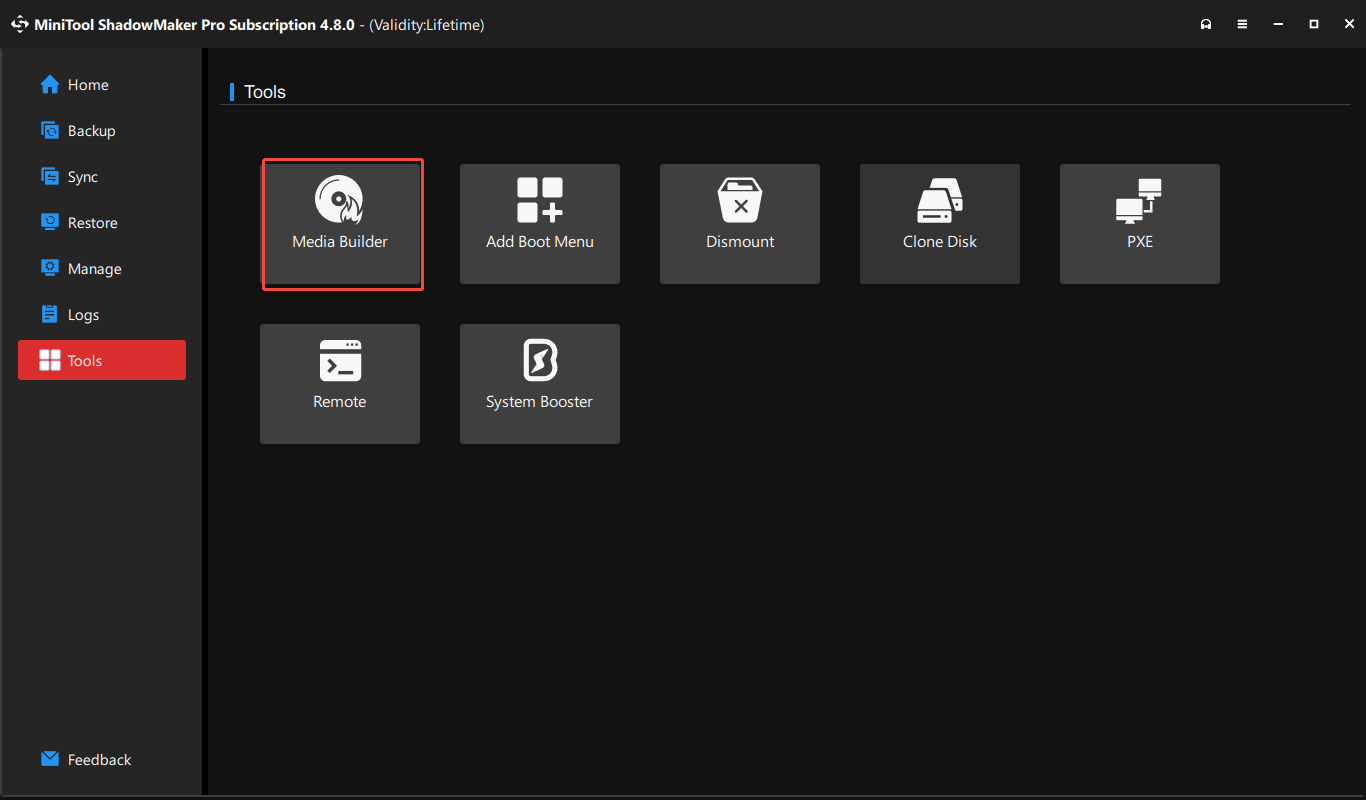
3. Follow the on-screen prompts to create a bootable USB drive.
Step 2: Boot to MiniTool recovery environment.
1. Insert the bootable USB drive into the unbootable computer.
2. Press Esc, Del, or F2 to enter the BIOS menu and set the PC to boot from that USB drive.
3. Under the recovery environment, launch MiniTool ShadowMaker.
Step 3: Perform file backup.
1. In the Backup page, hit SOURCE > Folders and Files, choose what to back up, and hit OK.
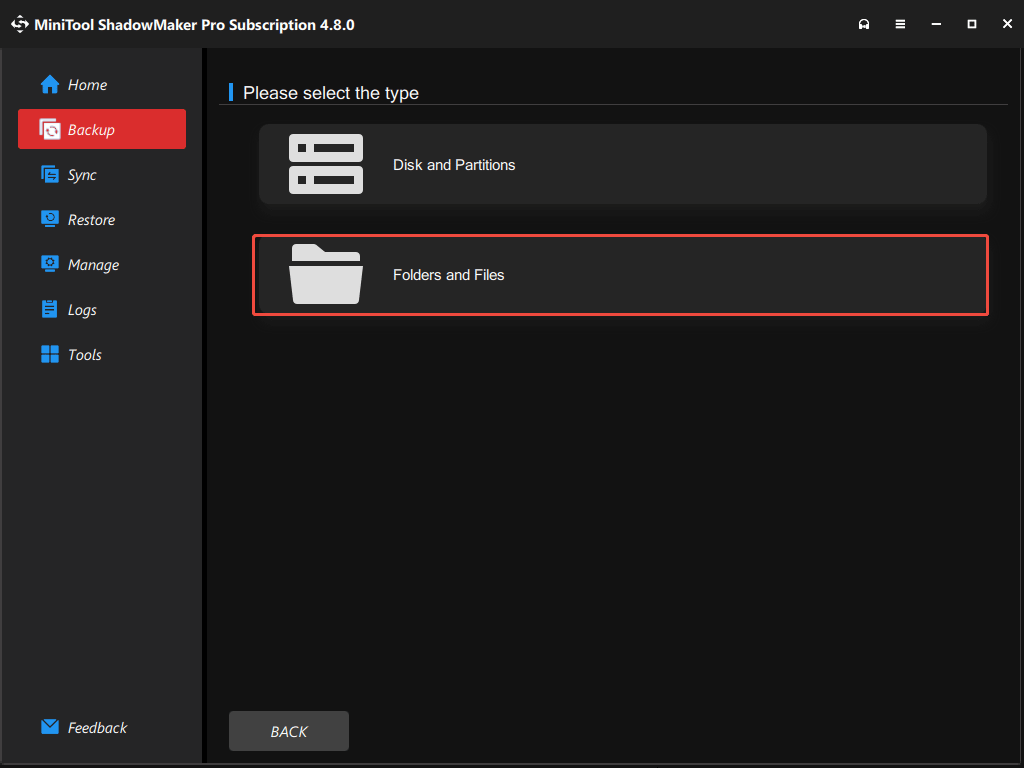
2. Click DESTINATION to choose a drive to save the backups.
3. Begin the backup by hitting Back Up Now.
Upon a backup, you are supposed to address the BSOD issue by taking the following troubleshooting steps.
How to Fix Ntoskrnl.exe BSOD Windows 11/10
If your computer fails to load to the desktop correctly, first, boot it to Safe Mode. After that, you can try several methods to fix the ntoskrnl.exe failed issue, such as repairing damaged system files, updating drivers, running CHKDSK, performing a system restore, and more.
#1. Repair Corrupted System Files
The ntoskrnl.exe blue screen error can stem from damaged system files on your computer. To check if this is the case, you should run a repair.
SFC, short for System File Checker, can verify the integrity of protected Windows system files and replace corrupted or incorrect versions with a cached copy.
To run the SFC scan:
Step 1: Launch Command Prompt as administrator by typing cmd in Search and hitting Run as administrator.
Step 2: Type sfc /scannow and press Enter to execute a scan.
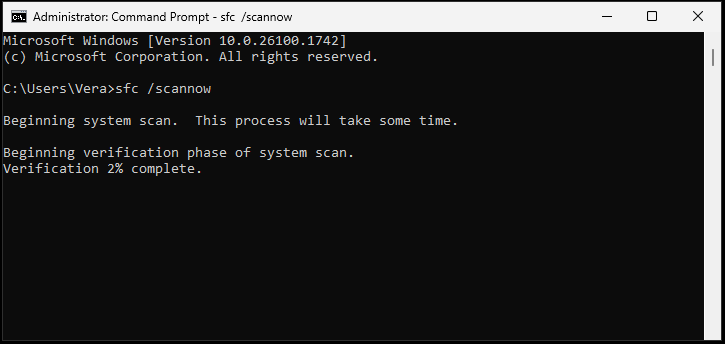
Step 3: Restart your computer for the changes to take effect.
#2. Run CHKDSK
The culprit of ntoskrnl.exe causing a BSOD may be the hard drive, so check it for any errors.
To implement the CHKDSK scan:
Step 1: Open an elevated Command Prompt.
Step 2: Run the chkdsk /f /r commands and press Enter. This will scan the C drive.
- /f: checks a file system for logical errors and attempts to fix them.
- /r: scans for and repairs file system errors, and detects bad sectors on the disk, then recovers readable data from them.
Step 3: Type Y and press Enter to confirm that you want the check to be performed next time your computer starts up.
Step 4: Restart the Windows 11/10 system. Then, Windows will begin a drive check.
#3. Update Drivers
Updating drivers is an excellent way to resolve many issues, including IRQL NOT LESS OR EQUAL ntoskrnl.exe. Have a try!
Step 1: Press Win + R, type devmgmt.msc, and click OK to open Device Manager.
Step 2: Look for any devices with a yellow exclamation mark. Right-click them and choose Update driver.
Step 3: Hit the first option to let Windows automatically search for the best available driver and install it on the device.
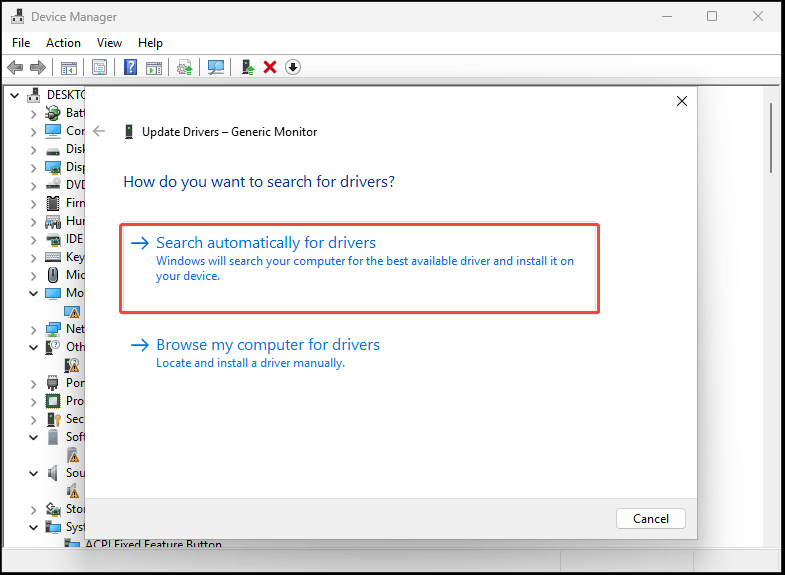
If this Windows has determined that the driver is already installed, take these steps:
Step 1: Visit the device manufacturer’s website.
Step 2: Search for the recent driver to download. Be sure to choose the driver that is compatible with your Windows version.
Step 3: Run the downloaded file to finish the driver installation.
After updating drivers, restart the system and check if Windows 11/10 ntoskrnl.exe BSOD persists. If the issue remains, proceed with the next solution.
#4. Perform a System Restore
System Restore can revert your system to a time when no issues existed. In case of ntoskrnl.exe causing a BSOD, eliminate the issue by doing a system restore.
Step 1: Open the Run window by pressing Win + R.
Step 2: Type rstrui.exe and press Enter to open the System Restore window.
Step 3: Hit Next and pick a restore point from the list that corresponds to a time when your computer was functioning correctly.
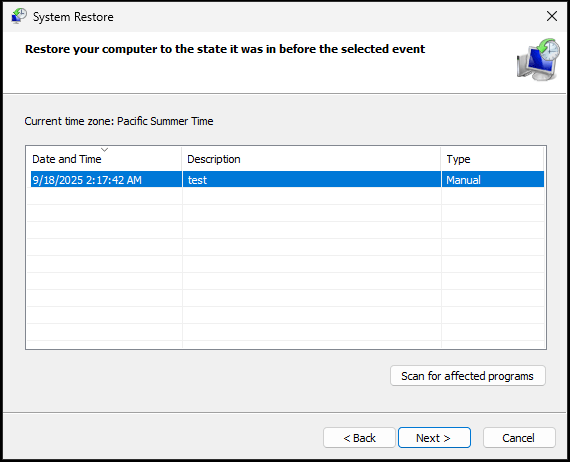
Step 4: Click Finish > Yes to begin the process.
Later, your Windows 11/10 PC may boot without a blue screen error.
#5. Check for Viruses and Malware
Viruses and malware can contribute to ntoskrnl.exe BSOD. We strongly advise that you perform a scan to ensure no infection is harming your PC.
As Windows Security does not function in Windows 11/10 Safe Mode, you can check for malicious software using a third-party antivirus program, such as Malwarebytes.
Step 1: Open Edge in Safe Mode and visit the website of Malwarebytes to download it, and then install it on your PC.
Step 2: Launch this antivirus software and perform a full scan. This will take several minutes.
Step 3: After the scan, remove the detected threats.
#6. Update BIOS
It is recommended to download and install the latest BIOS version for your motherboard. This can resolve potential hardware compatibility issues to address the ntoskrnl.exe BSOD.
To do this:
Step 1: Visit the manufacturer’s website.
Step 2: Download the new BIOS file to a USB drive.
Step 3: Boot the machine to the BIOS menu and use the built-in flashing utility to install the latest BIOS version.
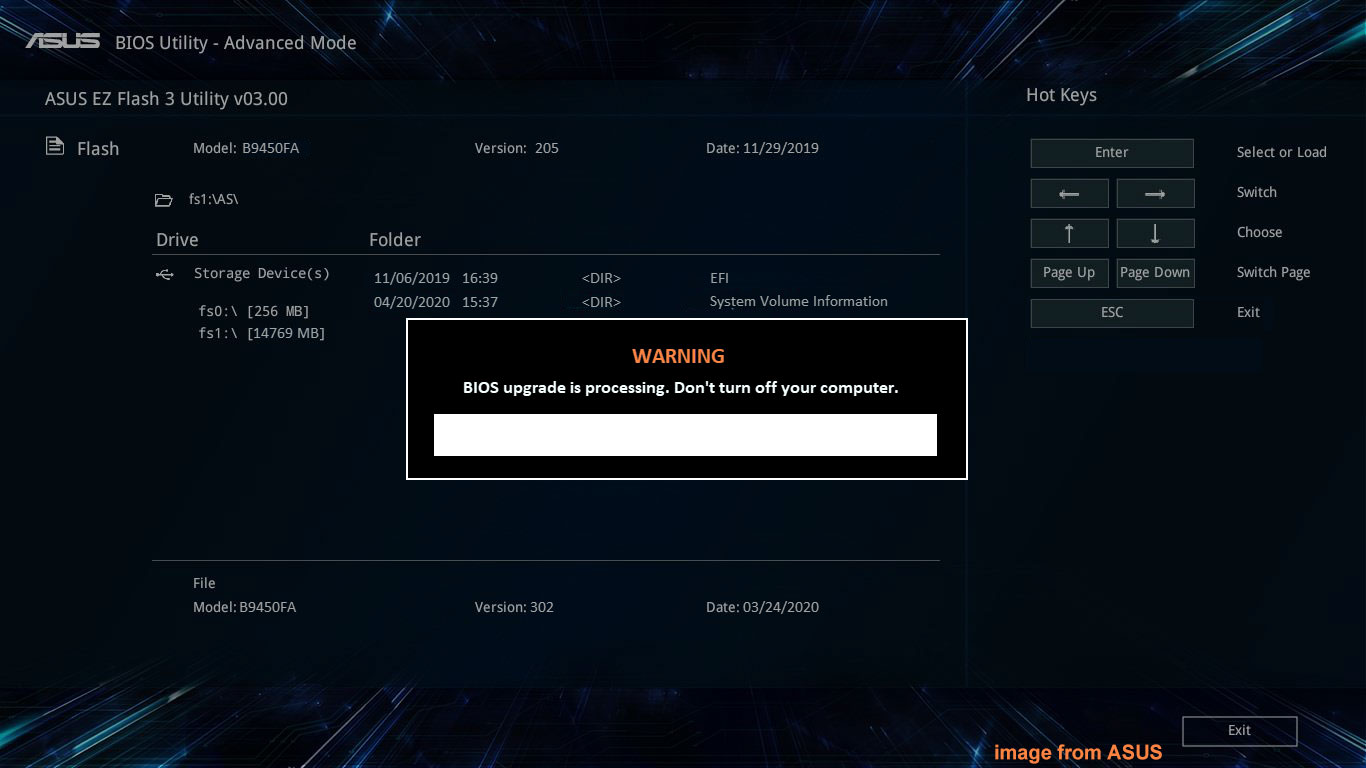
Here is a related guide on how to update BIOS with a USB for your reference.
#7. Disable Overclocking
Overclocking runs computer components at a higher clock speed and frequency than their factory-certified settings to achieve higher performance. However, it can cause system instability and blue screen errors.
If you have overclocked your CPU, GPU, or RAM, revert the settings to default values via the software you used or in the BIOS.
Do this as per your situation. For some details, you can search for the steps on Google. As for disabling CPU overclocking, refer to this guide on how to disable CPU overclocking.
#8. Install or Uninstall Windows Updates
In some cases, the ntoskrnl.exe failed error can be solved by installing the available Windows updates. These updates often bring new features, security patches, and bug fixes. It is recommended to try this method if updates have not been installed for a long time.
Step 1: Press Win + I to open Settings.
Step 2: Under Windows Update, check for updates.
Step 3: If there are some available updates, download and install them.
Step 4: Restart the system to finish the installation.
Sometimes, ntoskrnl.exe blue screen occurs after you install a Windows update. To fix the issue, uninstall the problematic update.
Step 1: Boot Windows 11/10 to WinRE by using installation media or the force interrupt method.
Step 2: Go to Troubleshoot > Advanced options > Uninstall Updates.
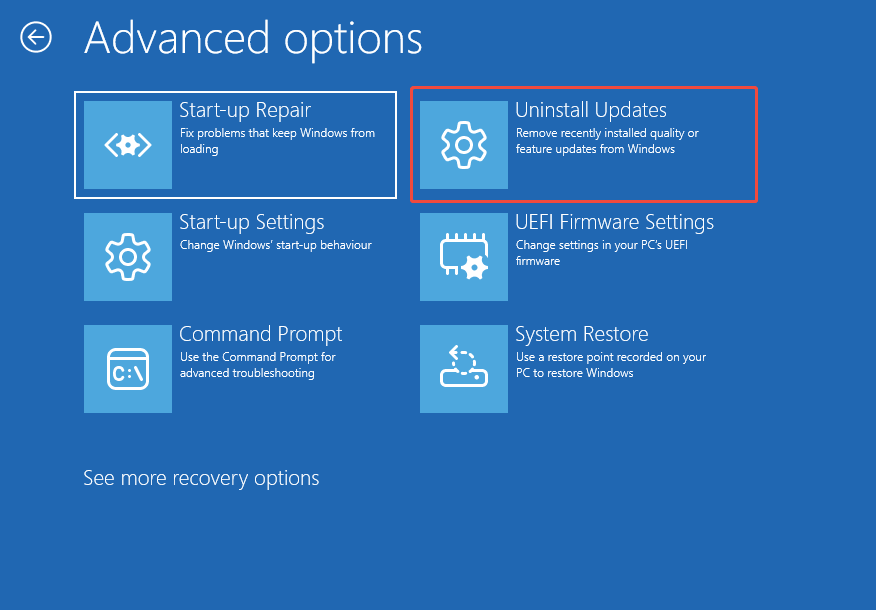
Step 3: Follow the prompts to uninstall the latest quality or feature update.
#9. Test RAM
A faulty RAM stick can also be the cause of Windows 11/10 BSOD ntoskrnl.exe. If the above methods don’t do the trick, try checking your RAM for errors.
In terms of a RAM test, you can run the built-in tool called Windows Memory Diagnostic that performs a basic scan.
For a deeper RAM analysis, we recommend MemTest86+.
Microsoft suggests you should run this free utility at least 8 passes for conclusive results. Besides, since it operates outside of an operating system, you need to create a bootable USB drive with MemTest86+ first. Then, perform a more thorough check for physical RAM errors.
After the test, if this tool detects some errors, you need to determine if it’s your RAM or if the DIMM slots are faulty.
Wonder about the exact steps? Here is a detailed tutorial from Microsoft about how to test RAM with MemTest86+.
Ntoskrnl.exe BSOD FAQ
1. Update Windows
2. Update device drivers
3. Scan for malware and viruses
4. Repair damaged system files
5. Perform a clean boot
6. Disable Windows Search service
1. DRIVER_IRQL_NOT_LESS_OR_EQUAL
2. PAGE_FAULT_IN_NONPAGED_AREA
3. CRITICAL_PROCESS_DIED
4. SYSTEM_SERVICE_EXCEPTION
These errors indicate different system problems and require different troubleshooting methods.
Summary
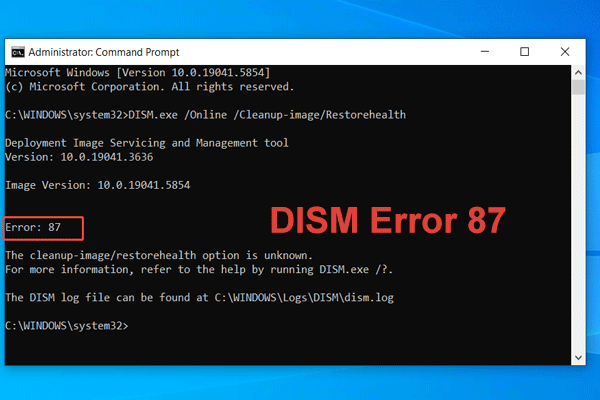
Ntoskrnl.exe BSOD on Windows 11/10 is typically caused by corrupted system files, outdated drivers, faulty hardware, or memory issues. To resolve this, start by running SFC and DISM scans, updating drivers, checking for Windows updates, and testing hardware.
If your system won’t boot, use Safe Mode, System Restore, or a recovery tool. Creating a system backup can help restore your PC quickly after BSOD errors. For suggestions or issues with MiniTool software, contact [email protected].
About The Author

Position: Columnist
Charlotte is a technology columnist with a strong focus on the Windows operating system, specializing in disk management, backup, and data recovery. She is passionate about analyzing computer errors, identifying root causes, and delivering practical solutions. In her free time, she stays updated on the latest developments in computer systems and hardware while continuously learning new technologies to broaden her expertise. Her writing style is clear and easy to understand, making complex technical topics accessible even to users with limited computer knowledge.
User Comments :