
Since its launch in 2020, the PlayStation 5 (PS5) has redefined next-generation gaming with its lightning-fast SSD, ray tracing capabilities, and immersive DualSense controller.
Yet for many gamers, one question persists: How much storage does the PS5 actually have? In the following part, this post will dive deep into the PS5’s storage and offer methods to expand PS5 storage space.
PS5 Models and Specifications
Since 2020, Sony has offered several PlayStation 5 (PS5) models. These are primarily categorized into the original models, the Slim models, and the Pro models.
What is the specs difference between the PS5 original, PS5 Slim, and PS5 Pro? Here is the table to show you the details:
| Component | PS5 Original | PS5 Slim | PS5 Pro |
| Storage Device | Custom PCIe 4.0 NVMe SSD | Custom PCIe 4.0 NVMe SSD | Custom PCIe 4.0 NVMe SSD |
| Capacity | 825 GB | 1 TB (Disc) 825 GB (Digital) | 2 TB |
| Sequential Read Speed | 5.5 GB/s (5,500 MB/s) | 5.5 GB/s (5,500 MB/s) | 5.5 GB/s (5,500 MB/s) |
| CPU | 8-core AMD Zen 2 (3.5 GHz) | 8-core AMD Zen 2 (3.5 GHz) | 8-core AMD Zen 2 (up to 3.85 GHz) |
| GPU | AMD RDNA 2, 10.3 TFLOPS | AMD RDNA 2, 10.3 TFLOPS | AMD RDNA 3, ~16.7 TFLOPS |
| RAM | 16GB GDDR6 | 16GB GDDR6 | 16 GB GDDR6 + 2GB DDR5 system memory |
| Optical Drive | Built-in (Disc) None (Digital) | Built-in (Disc) Detachable (Digital) | Optical (sold separately) |
| Audio | Tempest 3D AudioTech | Tempest 3D AudioTech | Tempest 3D AudioTech |
| Video Output | 4K 120Hz TVs, HDMI 2.1 | 4K 120Hz, HDMI 2.1 | 8K, 4K/120Hz, HDMI 2.1 |
| Ports | USB Type-C, USB Type-A x3 (1x Hi-Speed, 2x Super-Speed 10Gbps) | 2x USB Type-C ports | 2x front USB-C, 2x rear USB-A |
| Network | Ethernet, Wi-Fi 6, Bluetooth 5.1 | Ethernet, Wi-Fi 6, Bluetooth 5.1 | Ethernet, Wi-Fi 7, Bluetooth 5.1 |
| Dimensions (high x deep x wide) | 390 x 260 x 104mm (Disc); 390 x 260 x 92mm (Digital) | 358 x 216 x 96 mm (Disc); 358 x 216 x 80 mm (Digital) | 388 x 216 x 89 mm |
| Weight | 4.5 kg (Disc); 3.9 kg (Digital) | 3.9 kg (Disc); 2.6kg (Digital) | 3.1kg |
#1. PS5 Original (2020)
The original PS5 was released in late 2020, available in Disc and Digital editions. It has been discontinued and replaced by the Slim editions.
- PS5 Disc Edition: This model includes a built-in Ultra HD Blu-ray disc drive that can play physical PS5 and PS4 games, as well as 4K Blu-ray movies.
- PS5 Digital Edition: This model does not include a disc drive. It only supports digital games and media downloaded from the PlayStation Store and is therefore incompatible with physical discs.
#2. PS5 Slim (2023)
In 2023, Sony unveiled the PS5 Slim, a revised version designed to be smaller, lighter, and more energy-efficient. It retains the same core performance as the launch model but upgrades storage capacity.
- PS5 Slim Disc Edition: This model is smaller and lighter than the original PS5 disc edition, has more internal storage, and features a redesigned front USB port layout.
- PS5 Slim Digital Edition: While the slim digital version doesn’t include a disc drive, you can purchase a detachable Ultra HD Blu-ray drive accessory later and install it on the console if needed.
#3. PS5 Pro (2024)
Released in 2024, the PS5 Pro is Sony’s flagship performance model, targeting enthusiasts and 4K/8K gaming setups. It features substantial hardware upgrades, including a larger, faster SSD.
The PS5 Pro is slightly larger than the Slim but smaller than the original. It is sold as a digital-only console by default, requiring a separately purchased detachable disc drive accessory for physical media playback.
How Much Storage Does the PS5 Have?
In recent years, Sony has released improved versions (Slim and Pro) to meet consumer demand for larger capacity and more flexible storage options. As of 2026, there are three main PS5 models available, each with a different storage capacity.
How Much Storage Does the PS5 Original Have?
The original PS5 (disc and digital editions) comes equipped with a total capacity of 825 GB.
However, not all of the 825 GB is usable. The console’s operating system, firmware, and system updates will occupy approximately 158 GB of space, leaving only 667 GB of usable storage for games, applications, and media files.
How Much Storage Does the PS5 Slim Have?
The PS5 Slim disc edition upgrades to a 1TB built-in SSD, while the Slim digital edition retains its 825GB storage capacity.
For the Slim disc version, the system footprint remains unchanged, with approximately 842GB of usable space. This is a significant improvement for players who prefer physical discs but want more space to download digital games and updates.
The Slim digital edition still offers 667GB of usable space, the same as the original Digital Edition.
How Much Storage Does the PS5 Pro Have?
The PS5 Pro features a 2TB built-in SSD. This is the largest base storage capacity of any PS5 model.
While the total capacity is 2TB, the actual usable space for games, apps, and media is slightly less, typically around 1.84 TB, due to the space reserved for the system software and other operating system functions.
Further Reading:
Why does the PS5 use non-standard capacities (825GB, 2TB)?Gamers often wonder why Sony chose 825GB instead of 1TB for the base PS5.
According to PS5 lead designer Mark Cerny, 825GB is the optimal match for the console’s 12-channel SSD interface. This proprietary design allows Sony to fine-tune performance, striking a balance between speed, cost, and physical space constraints.
Sony followed the same logic for the PS5 Pro’s 2TB hard drive. The 2TB capacity aligns with advancements in NAND flash memory technology, providing twice the storage capacity of the Slim disc version in a more cost-effective way while maintaining PCIe 4.0 x4 speeds.
How to Expand PS5 Storage Space?
It’s worth noting that game sizes are growing rapidly. This means that even the Pro version’s 1.84TB of available space may quickly fill up for players who like to install multiple games. Therefore, expanding storage space is often essential.
Sony offers three official expansion methods for the PS5:
- M.2 NVMe SSDs (for direct gameplay)
- USB drives (for storage only)
- Cloud storage (for save files)
Each option has distinct requirements, benefits, and use cases.
Method 1. Add an Internal M.2 NVMe SSD
The most versatile expansion method is installing a compatible M.2 NVMe SSD into the PS5’s dedicated internal expansion slot.
This allows you to store and play both PS5 and PS4 games directly from the SSD, with performance matching the internal drive.
Before that, your M.2 SSD should meet the following requirements:
| Interface | PCI-Express Gen4x4 supported M.2 NVMe SSD (Key M) |
| Storage space | 250 GB – 8 TB |
| Form factor | 2230, 2242, 2260, 2280, 22110 |
| Size | Width: up to 25 mm Length: 30/42/60/80/110 mm Thickness: up to 11.25 mm (up to 8.0 mm from above the board, up to 2.45 mm from below the board) |
| Sequential read speed | 5,500MB/s or faster is recommended |
| Socket type | Socket 3 (Key M) |
| Heatsink | Mandatory (single-sided or double-sided |
The internal SSD speed is approximately 5,500 MB/s across all PS5 models. When adding an internal M.2 SSD, a speed of 5,500 MB/s or faster is required to ensure optimal performance.
Here are some top M.2 SSD recommendations for you:
- Samsung 990 Pro 4 TB: 7450 MB/s read, 6900 MB/s write; compact heatsink included
- Western Digital SN850X 8 TB: 7300 MB/s read, 6600 MB/s write; compatible with PS5’s size constraints
- Seagate FireCuda 540 2 TB: 7300 MB/s read, 6600 MB/s write; optimized for gaming with Sony’s approval
Now you can install the internal M.2 SSD. However, you’ll need a Phillips screwdriver.
Before installing it, touch a grounded metal object to discharge any static electricity. Otherwise, you may damage your M.2 SSD or PS5 console.
Follow the steps below:
- Completely power off the PS5 and unplug all cables and devices.
- Place the console on a flat surface with the PlayStation logo facing down, with the power button facing you (for original and Pro models) or facing away from you (for Slim models).
- Grab the top left corner of the cover and gently pull it up and to the right (or slide it down, depending on the model) until it comes off.
- Locate the rectangular metal cover. Use a Phillips screwdriver to unscrew the screws securing the cover, and then remove it.
- Install the M.2 SSD, and then secure it in place with the screws.
- Reassemble the console.
- Replace the cover, reconnect cables, and power on the console.
- Format the SSD. A formatting guide will appear on the screen. Follow the on-screen instructions to format the new M.2 SSD for use.
Once formatted, the M.2 SSD will appear as a separate storage option in your game library. You can install new games directly to it or move existing games from the internal SSD via the “Move Games and Apps” menu.
Method 2. Add an External USB Drive
Adding a PS5 external USB drive is a simple method to expand your storage. It allows you to store PS5 games and store/play PS4 games directly from the external drive.
The PS5 supports external USB 3.2 Gen 1 drives with capacities ranging from 250 GB to 8 TB. These USB drives are suitable for:
- Arranging infrequently played PS4 games.
- Storing PS5 game installation files to avoid re-downloading.
Before connecting the external drive with a PS5 console for the first time, the drive needs to be formatted. The PS5 requires external drives to be formatted in its proprietary extended storage format, exFAT.
To format the drive on the PS5 console, first connect the USB drive to your PS5, then go to Settings > Storage > USB Extended Storage > Format as USB Extended Storage.
If your PS5 console is failing to recognize the drive, format the hard drive on your computer.
As a free partitioning software, MiniTool Partition Wizard is worth trying. It supports formatting hard drives to various file systems, including exFAT, NTFS, FAT32, and Ext2/3/4.
What’s more, it can be used as a USB formatter, SD card formatter, FAT32 formatter, and more.
Now, download and install this software. Then, try the following steps to format the drive.
MiniTool Partition Wizard FreeClick to Download100%Clean & Safe
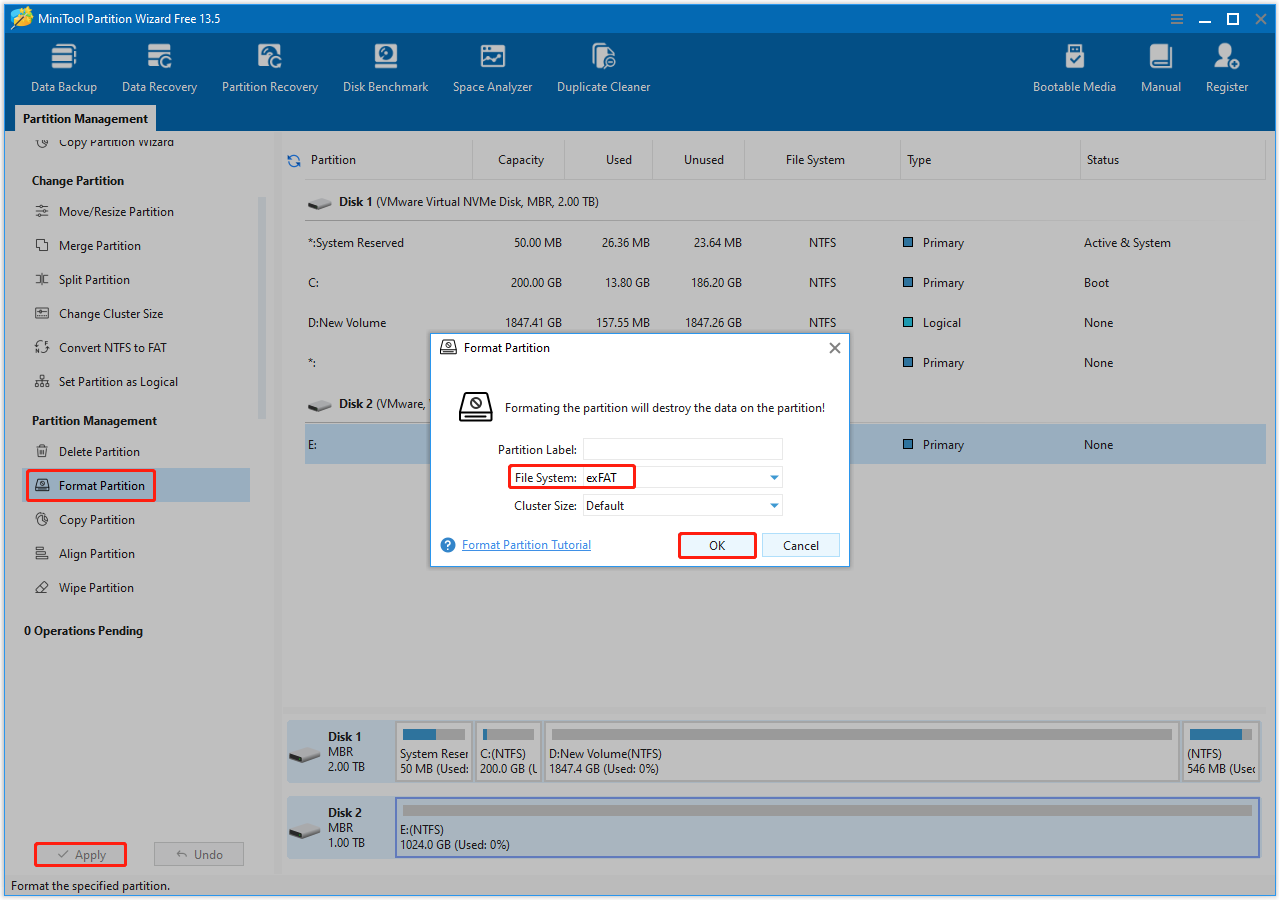
- Launch this software to enter its main interface, and then highlight the partition on the external drive.
- Choose the Format Partition feature from the left action panel.
- In the pop-up window, set the File System to exFAT. Then click OK.
- Click Apply to confirm the changes.
Method 3. Use Cloud Storage
Cloud storage is not a replacement for local storage, but it’s a critical tool for managing saved data. PlayStation Plus (PS Plus) members get 100 GB of cloud storage for PS5 and PS4 save files.
How to Free Up Storage Space on PS5?
If you don’t want to invest in external drives or M.2 SSDs, there are several effective ways to free up space on your PS5’s internal storage.
#1. Delete Unused Games and Apps
Games and applications consume the most storage space. Deleting them is the quickest way to free up significant room, and you can always re-download them later from your game library.
- Go to Settings > Storage > Console Storage > Games and Apps.
- Select the items you want to remove. You can select multiple items to delete at once.
- Select Delete and confirm.
#2. Clear Screenshots and Video Clips
The PS5 automatically records gameplay and saves screenshots when you press the Create button. Over time, these files can accumulate and take up gigabytes of space.
Here is how to delete media files:
- Go to Settings > Storage > Console Storage > Media Gallery.
- Select the Select Multiple icon to choose which items to delete, or use the Options button on a single item to delete it.
#3. Delete Saved Data
Game saved data takes up less space than game installations, but deleting it can help. Here is the guide:
- Go to Settings > Saved Data and Game/App Settings.
- Select Saved Data (PS5) or Saved Data (PS4).
- Choose Delete from Console Storage, select the files, and confirm the deletion.
How Much Storage Does the PS5 Have FAQ
1. Go to your games home and select Game Library.
2. Highlight the data to move, press the Options button, and then select Move games and Apps. When you’re using both an M.2 SSD and a USB drive, go to the Movable to M.2 SSD Storage tab.
3. Select the checkboxes for any other games and apps, then select Move.
Key solutions include deleting unused titles, transferring PS4 games to an external USB hard drive, or installing a compatible M.2 SSD for additional internal storage.
PS5 games can be moved to USB extended storage, but they need to be copied back to console storage or M.2 SSD storage to be played.
Other common reasons include game add-ons not being removed, media captures, or the system needing extra buffer space for installation.
While both utilize fast NVMe SSDs, the Xbox Series S features a smaller 512GB drive. Both consoles support expandable storage, with Xbox using proprietary expansion cards and PS5 allowing standard, certified M.2 NVMe SSDs.
Bottom Line
As game sizes continue to increase, storage space will remain a crucial consideration for PS5 users. By understanding the console’s storage capacity and making full use of expansion options, you can enjoy all your favorite games.
For any questions or suggestions with MiniTool Partition Wizard, contact us via [email protected].
User Comments :