
As an American multinational corporation and technology company headquartered in Santa Clara, Intel Corporation is a world-famous semiconductor chip manufacturer. Its 660p series SSD wins the heart of the public since it has many advantages, such as good performance and fast speed.
Please resort to MiniTool if you’d like to protect your SSD better.
The Price of Fast & Massive Intel 660p 1TB SSD Is Falling
The Intel 660p is a famous product of Intel; it adopts the Quad-Level Cell (QLC) NAND flash, also known as the four bit per cell. Though the new TLC NAND can offer better performance and endurance, the Intel SSD 660p still uses QLC NAND since it is always the cheaper lower-quality alternative.
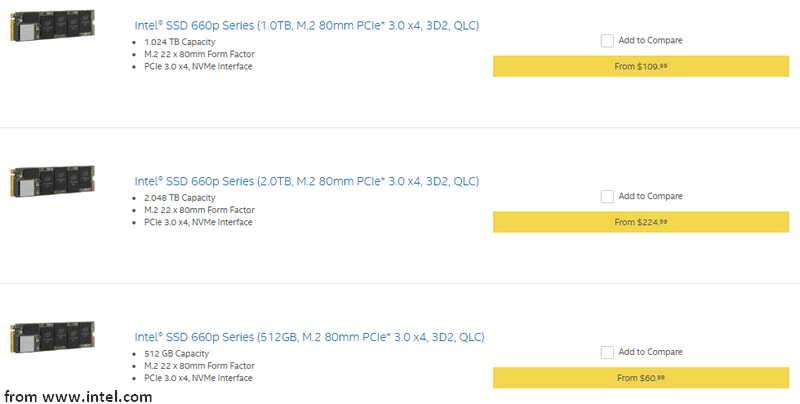
The Intel SSD 660p series product attracts the attention of many people mainly because it has many advantages including impressive power efficiency.
Now, the exciting news is that you can get the 1TB Intel 660p M.2 2280 NVMe SSD for just $99.99 at Newegg (the original price is $194.99). The 660p is a reliable solid state drive with fast and stable sequential read and write speeds.
NVM Express Is A New Interface For Computer Communication.
Intel 660p Review
The Intel 660p NVMe SSD is a bit of shock to the system. In this part, I will introduce it to you from the following aspects.
One: design & feature.
What surprise users the most is that there is no label or heat sink on 660p SSD. You can find only two memory chips on one side; it seems that the DRAM chip is put under a metal cover. In addition, up to four chips can be mounted on each side.
Two: speed & endurance.
The Intel NVMe SSD is a reliable product for all PCs and laptops. There are three aspects to support this statement.
Aspect 1: the read and write speeds are very fast.
- The sequential read speed: 1,500 MB/s (512GB model), 1,800 MB/s (1TB model), 1,800 MB/s (2TB model)
- The sequential write speed: 1,000 MB/s (512GB), 1,800 MB/s (1TB), 1,800 MB/s (2TB)
- The random read: 90,000 IOPS (512GB), 150,000 IOPS (1TB), 220,000 IOPS (2TB)
- The random write: 220,000 IOPS (512GB), 220,000 IOPS (1TB), 220,000 IOPS (2TB)
Aspect 2: it uses 256-bit AES encryption to secure data and provides a 5-year limited warranty. (SSD data recovery is possible.)
Aspect 3: it has strong endurance. The write endurance values for 512GB Intel 660p, 1TB Intel 660p, and 2TB Intel 660p are respectively: 100 TBW, 200 TBW, and 400 TBW.
Three: dynamic cache.
The Intel 660p NVMe SSD gives support to both the static DRAM and SLC caches. Although SLC is the variable-sized secondary cache, it is the decisive factor for the sustained performance.
How to change the size of the cache?
You should write only one bit to treat a portion of the main body of QLC as SLC. Apparently, this is much faster than writing the four bits completely. The Intel NVMe SSD will assign more QLC to be treated as SLC according to needs. The contents will be sent to QLC to write the full four bits at the right time.
All in all, the Intel 660p is definitely a good choice for users to upgrade their laptop as long as it has a M.2/PCIe NVMe slot and allows booting from NVMe.
Another product of Intel – the Optane Memory M15 – is intended for caching use.
Intel Makes Great Efforts to Provide Bigger & Cheaper SSD
As you all know, one of the most important reasons why solid state drives have developed so rapidly is the fast speed. Booting from the SSD is much faster than booting from the traditional hard drives. However, when it comes to the cost and capacity, the old hard drives win, of course.
Intel decides to improve the situation; it promises to add more advanced technologies (for instance, five-level cells) to SSDs so as to squeeze more data into each memory cell. In this way, the capacity will be improved a lot and the price will fall.
User Comments :