
New Toshiba M.2 SSD targets composable infrastructures, data centers and high-end workstations with new low-power, small-form-factor 2 TB M.2 SSD that uses dense 96-layer 3D NAND flash. Now, you can read this post to get more information about this new SSD.
Toshiba Memory America is a company that is focused on capacity and performance with the latest small-form-factor, NVMe-based M.2 solid-state drive with low-power which targets high-end workstations, data centers and composable infrastructures.
As one of the newer enterprise use cases for M.2 SSDs, composable infrastructure often acts as boot drivers in servers. Startup Liqid has already signed on to integrate the new Toshiba M.2 SSD into the software-defined composable infrastructure platform.
Toshiba XG6-P M.2 SSD is not similar to the heavy-duty data center SSD. It lacks enterprise features like power loss protection and dual ports. As a managing partner at G2M Research, Mike Heumann said that NVMe-based M.2 SSDs are used mainly in scenarios where storage capacity requirements are low and data tends to be static.
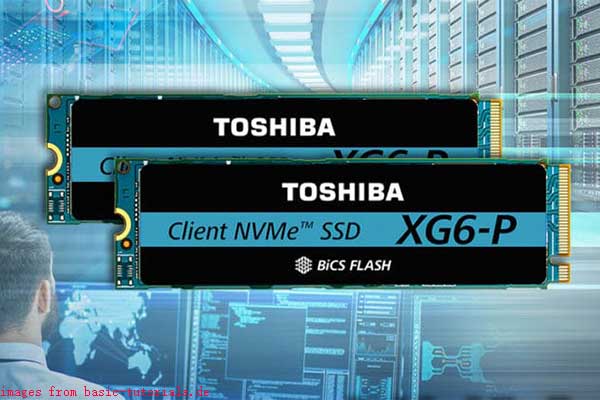
However, the Toshiba product line manager Grant Van Patten said that the vendor has already received requests for larger capacity M.2 client SSDs that respond well when running under sustained write workloads.
Dense 96-Layer 3D NAND
Toshiba’s new XG6-P client SSD uses the company’s latest triple-level cell and 96-layer 3D NAND flash technology to get large capacity in a small footprint. The maximum capacity of the new Toshiba M.2 SSD is 2TB which doubles the 1TB limit of the XG6 model which was introduced at the end of 2018.
Grant Van Patten said:
Liqid is a good example of a customer that was asking us for more density. In their application, when we deliver a 2 TB drive, that means they can build an 8 TB drive. That enables them to compete in a different class of product themselves.
Liqid says that its composable fabric is designed for artificial intelligence, machine learning, genomics research & high-performance modeling, research, and development workloads. Its startup Command Center software pools server resources like CPU, SSDs, GPUs and NICs. It allows its customers to segment those resources.
Last month, Liqid secured an OEM deal with Dell EMC which aimed to sell its products with PowerEdge servers. On the startup’s website, it claims that Liqid has tested NVME technology from Samsung and other vendors, in addition to Toshiba and its own products.
Van Patten also said that Liqid has the plan to combine four of Toshiba’s XG6-P client SSDs to get higher capacity and unified performance of more than a million IOPS. Additionally, in Liqid’s application, raw performance and cost are more important than endurance.
XG6-P VS. Predecessors
This new Toshiba M.2 SSD has a 30% improvement in the performance of sequential & random write, and a 15% development in random-read speed over its XG5-P predecessor and matches the XG6 performance.
Although the XG6-P and XG6 use the same controller, the XG6-P possess different firmware and full-range DRAM to balance and sustain performance.
The XG6-P SSD is using the ultrafast NVMe-based PCI Express (PCIe) Gen 3 technology. Thus, it has low-latency and consistent performance. According to the statement of the company, the XG6-P drive can deliver up to 3.2 GBps of sequential read speed and 2.9 GBps of sequential write speed. The random read and write speed can reach up to 355,000 IOPS and 365,000 IOPS.
In addition, this new Toshiba M.2 SSD can also meet the enterprise needs for operations like logging and caching in servers. The client SSD tends to focus on background operations. However, this drive is not going to replace the enterprise drives or data center drives.
Indeed, this new SSD is the best choice if you concern about the cost of flash. The power consumption is only about 5 watts in active mode. In idle mode, it can be a single watt or ecen less. However, in idle mode, an enterprise SSD can be at 5 or 10 watts.
The company is going to sell the drive through OEMs. Thus, the price is unavailable now.
About The Author

Position: Columnist
Stella has been working in MiniTool Software as an English Editor for more than 8 years. Her articles mainly cover the fields of data recovery including storage media data recovery, phone data recovery, and photo recovery, videos download, partition management, and video & audio format conversions.
User Comments :