
The new Aorus NVMe Gen 4 SSD is designed by Gigabyte. The sequential read and write speeds of this new PCIe 4.0 SSD are very fast (about 40% faster than the previous technology). Apart from the fast speed, the Aorus SSD also has many other advantages waiting for you to find out.
Aorus NVMe Gen 4 SSD, Fast Speed & High Performance
Blazing Speeds: up to 5GB/s
Designed by Gigabyte, the new Aorus NVMe Gen 4 SSD will arrive sometime in July. It is designed to please mainly overclockers. One of the biggest advantages of Aorus NVMe (Non-Volatile Memory Express) SSD is the ultra-fast speed.
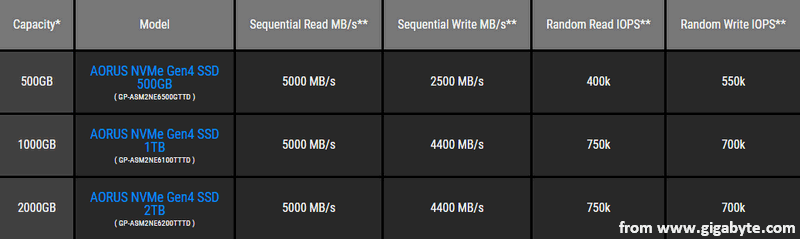
The sequential read speed of the Aorus NVMe SSD (both 1TB model and the 2TB model) is 5000 MB/s while the sequential write speed is up to 4400 MB/s. The fast speeds are achieved largely owe to the PCIe Gen 4 interface, which delivers a speed much faster than the PCIe Gen 3. The read speed of PCIe Gen 4 is 40% faster than that of PCIe Gen 3, while the write speed is 30% faster. Besides, the Random Read IOPS and Random Write IOPS are respectively: 750k and 700k.
PCIe SSD Or SATA SSD, Which Is The Best One For You?
A new motherboard is needed in Aorus NVMe solid state drive to give support to tech, such as one of Gigabyte’s X570 series as well as one of AMD’s incoming Ryzen 3000 processors. X570 is the new PCIe 4.0-toting chipset of AMD and it offers good performance for SSD. Gigabyte has improved the motherboard of Aorus NVMe SSD by using low inductance, 16-phase digital power, server-grade circuit boards, and advanced thermal design.
What’s more, the size of this PCIe 4.0 SSD is small; it’s 80.5mm*23.5mm*11.4mm. This makes Aorus NVMe Gen 4 an SSD easy to carry around.
Toshiba BiCS4 96 Layers 3D TLC
There are many merits in Aorus NVMe PCIe 4.0 SSD, such as the fully copper based heatsink, the world first PCIe 4.0×4 controller, Phison PS5016-E16 controller, and the 3D TLC (triple-level cell) NAND flash memory.
The BiCS4 96 Layers 3D TLC from Toshiba is able to help optimize the circuitry and architecture by increasing to 96 layers. In this way, there will be higher storage space in each unit area and the throughput can be up to 800MT/s, which is far more than that of the PCIe 3.0×4 devices.
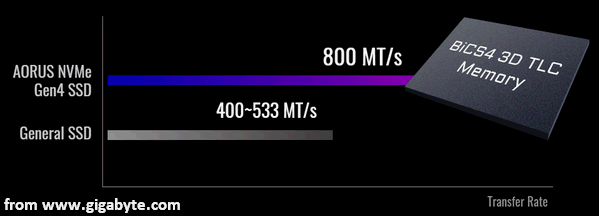
All in all, the Toshiba BiCS4 96 Layers 3D TLC NAND Flash contributes a lot to the high quality and superior storage performance.
Full Body Copper Heatsink
The Aorus NVMe Gen 4 SSD can become very hot when it reaches the top read and write speeds. However, the wonderful heatsink design has solved the problem by reducing the temperature greatly (by about 14 percent).
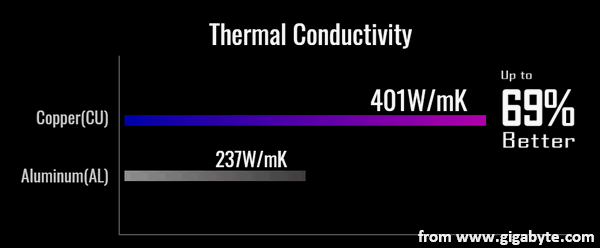
The Full Body Copper Heatsink is designed after taking the heat transfer from key components into account. Where are those key components? They are actually located on the front & back of the device, the controller and the TLC NAND flash. The heat transfer capacity of the full copper heatsinks has been increased by 69% when it is compared to the traditional aluminum heatsinks. Thus, the Aorus NVMe Gen 3 SSD and NVMe Gen 4 SSD are given with the best heat dissipation for read/write performance.
Equipped with 27 fins, the new copper heat spreaders is very efficient. The surface area of the copper heat spreaders is more than that of the plated M.2 heat spreader. Because of this, the thermal transfer from heating sources has been improved so as to reach thermal balance in a shorter time.
What’s more, the fin array design is improved to carry out great heat exchange with the air flow from any direction.
Those designs work together to make Aorus PCIe 4.0 SSD components keep proper working temperature even under ultra-high data transfer rate.
User Comments :