
Microsoft expanded support for Windows 10 Enterprise and Education fall editions, which means enterprises have upgraded Windows 10 once a year from the start. The 30-month support extension for enterprises makes annual feature upgrades doable. If you want to get more information, click MiniTool to browse.
Enterprises Have Upgraded Windows 10 Once a Year from the Start
Enterprises have upgraded Windows 10 once a year from the start because Microsoft extended support for Windows 10 Enterprise and Education. In this way, organizations upgrade the OS once a year more easily. However, it just succumbed to a reality that had existed since the operating system debuted in 2015.
In a September 2018 document whose title is Joint FAQs, Microsoft confirms that many larger customers have been upgrading every year since they started using Windows 10.
Microsoft executive Jared Spataro has said that all future feature updates of Windows 10 Enterprise and Education will be released in September (starting with 1809) and supported within 30 months since release, which offers customers longer deployment cycles time to plan, test, and deploy.
Previously, all Windows 10 SKUs (stock-keeping units) came with free support for 18 months.
The 30-month support extension for enterprises makes annual feature upgrades entirely feasible. Even the most inflexible organizations can slow down the pace of Microsoft’s Windows as a service if they exclusively deploy upgrades each fall.
It turned out that they were so eager to get out of Microsoft’s six-monthly upgrade rate which they had been doing every year since the beginning.
Microsoft told in the FAQ for its partners that not every customer was able to test every release during the six-month release pace, and in fact, a large number of customers adopted 1607, and many then adopted 1709 and skipped 1703.
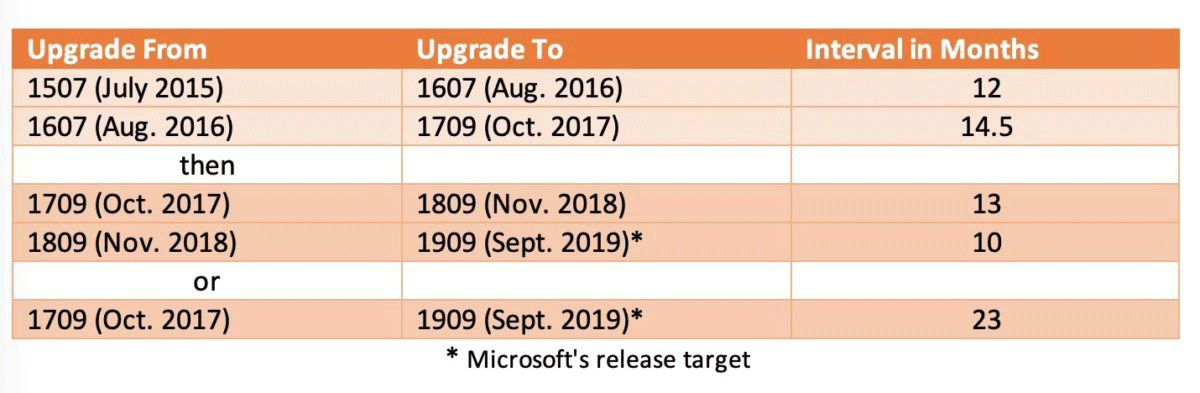
Whether 1607 was an upgrade from the original 1507 or a first deployment of Windows 10 with 1607, users of 1607 exceeded the April 2017 version 1703 and landed on 1709 at some point after the latter release in October 2017.
From this point of view, this is just a guess, since Microsoft released the FAQ four months later in 1803 and three and a half months earlier before 1809, it is ready for the boldest challenge. One possibility is that enterprises that upgrade from 1709 to 1809 even face a disastrous first release and re-launch.
More likely, organizations correctly avoided the 1809 debacle and, knowing that each yy09 version had 30 months of support, decided to wait until version 1909 is released this year. Enterprise and Education will support 1709 until April 14, 2020, so these customers will have about seven months to migrate from the expected release of 1909.
According to the FAQ, Microsoft decided to formalize this tempo to formalize the way customers behave, with the goal of offering relief to these customers.
Microsoft added that some customers may have normalized to the releases of March/April and these customers are skipping one. These users refer to organizations that also made annual upgrades but chose to upgrade yy03.
No doubt these enterprises want to delay the release to yy09 to get 30 months of support, which means they need to upgrade a second time six months after the first upgrade or move from spring to fall after 18 months.
However, Microsoft’s message to its partners, and hence to its customers, is even harsher for customers who are not running the pricier Windows 10 Enterprise/Education SKUs
In response to a question about why this change doesn’t apply to Windows 10 Home and Pro users, Microsoft said it was pleased with the success of twice-yearly updates to customers and these people will not face deployment management challenges which drive larger customers to take extra time.
If customers of small businesses have complex IT environments that require longer service cycles, they should evaluate whether Enterprise Edition is a right choice for them.
Bottom Line
To sum up, this post has shown you that enterprises have upgraded Windows 10 once a year from the start. In this way, it is easier for organizations to upgrade the OS one time a year.
User Comments :