
A 128GB SD card can be formatted to FAT32, but Windows limits FAT32 formatting to 32GB by default. To format 128GB SD card to FAT32, you need to use a third-party FAT32 formatter, like MiniTool Partition Wizard. Check out this MiniTool guide for details.
Hey guys. I have a 128GB SD card that I need to format to FAT32 so it can work with my camera. I tried formatting the card on Windows using Disk Management, but it won’t let me choose FAT32 for a card this big. How to format 128GB SD card to FAT32? Any free methods or tools that actually work would be really helpful.forums.sandisk.com
Quick Answer:
You can format a 128GB SD card to FAT32 on Windows 11/10. However, Windows does not allow FAT32 formatting for drives larger than 32GB.
To format a 128GB SD card to FAT32, you need a dedicated FAT32 formatting tool like MiniTool Partition Wizard Free.
Scenario: Windows Won’t Format a 128GB SD Card to FAT32
Many 128GB SD cards use exFAT by default. However, some devices still require FAT32, such as Nintendo 3DS, Sony PSP, and certain models of cameras.
If you try to format a 128GB SD card in File Explorer or Disk Management, FAT32 does not appear as an option. This is not a formatting error. Windows intentionally limits FAT32 formatting for drives larger than 32GB in the built-in disk management tools.
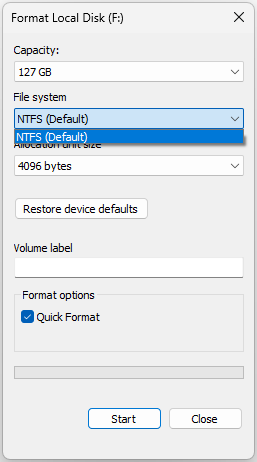
Although Windows restricts the formatting option, FAT32 itself supports much larger partition sizes, up to 2TB or 16TB. This means a 128GB SD card can still be formatted to FAT32 by using dedicated FAT32 formatting software.
For example, tools such as MiniTool Partition Wizard can bypass the Windows limitation and create a FAT32 partition on large SD cards.
3 Steps to Format a 128GB SD Card to FAT32
MiniTool Partition Wizard supports formatting 64GB, 128GB, 256GB, and larger SD cards to FAT32 and other file systems.
The Format Partition feature is available for free.
MiniTool Partition Wizard FreeClick to Download100%Clean & Safe
This tool is fully compatible with Windows 11/10/8/7. I tested its formatting feature on a 128GB virtual hard disk in VMware running Windows 11.
Full steps:
Step 1. Run MiniTool Partition Wizard Free to enter its main interface. Select the 128GB partition, then click Format Partition.
Step 2. Expand the drop-down menu of File System, and choose FAT32. After that, click OK.
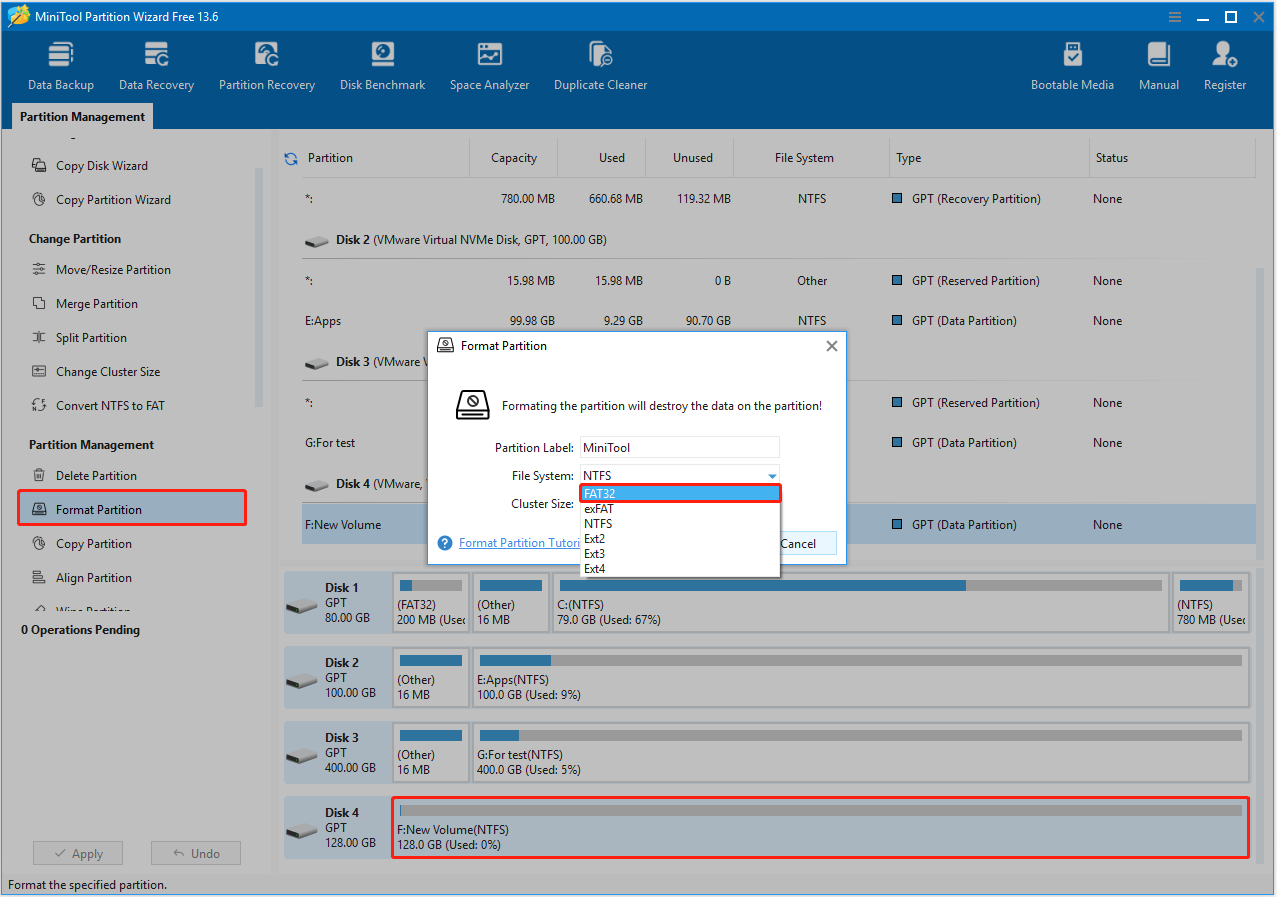
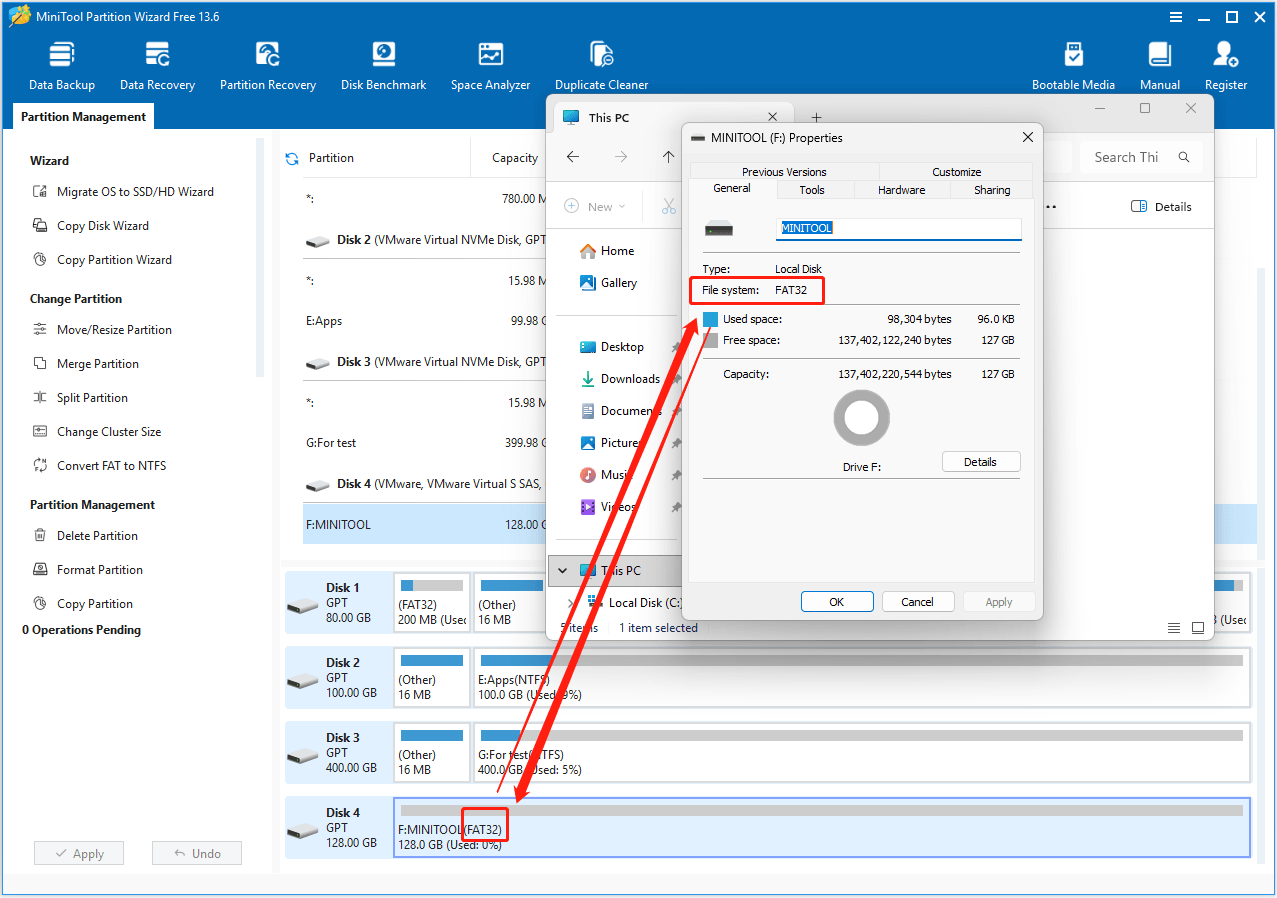
Step 3. Finally, click Apply to confirm the operation. After formatting is complete, the 128GB disk will use the FAT32 file system. You can open the disk properties window in File Explorer to verify that the file system is FAT32.
Here is a video guide.
Another Case: No FAT32 Option When Creating a New Partition
The FAT32 option may also be missing when creating a new partition on a 128GB SD card.
During the partition creation process in Disk Management, Windows usually provides only exFAT or NTFS, but FAT32 is often unavailable.
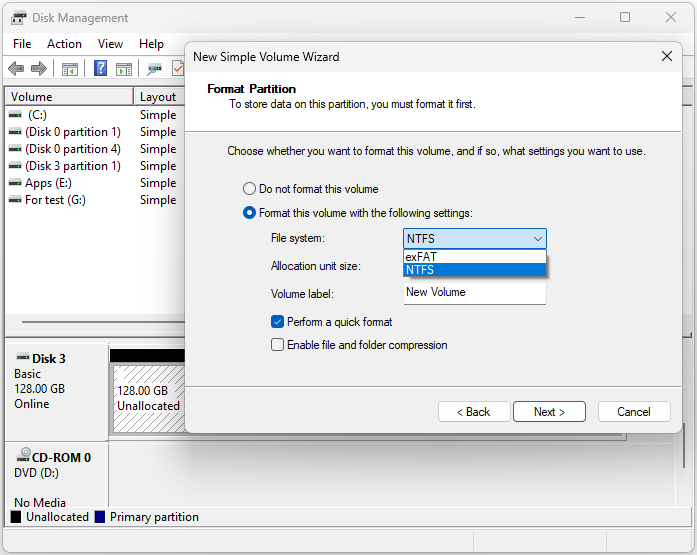
To create a new FAT32 partition on a 128GB SD card, you can also use MiniTool Partition Wizard.
Detailed steps:
Step 1. Select the unallocated space and click Create Partition.
Step 2. Choose the FAT32 file system and specify other disk information. After that, click OK.
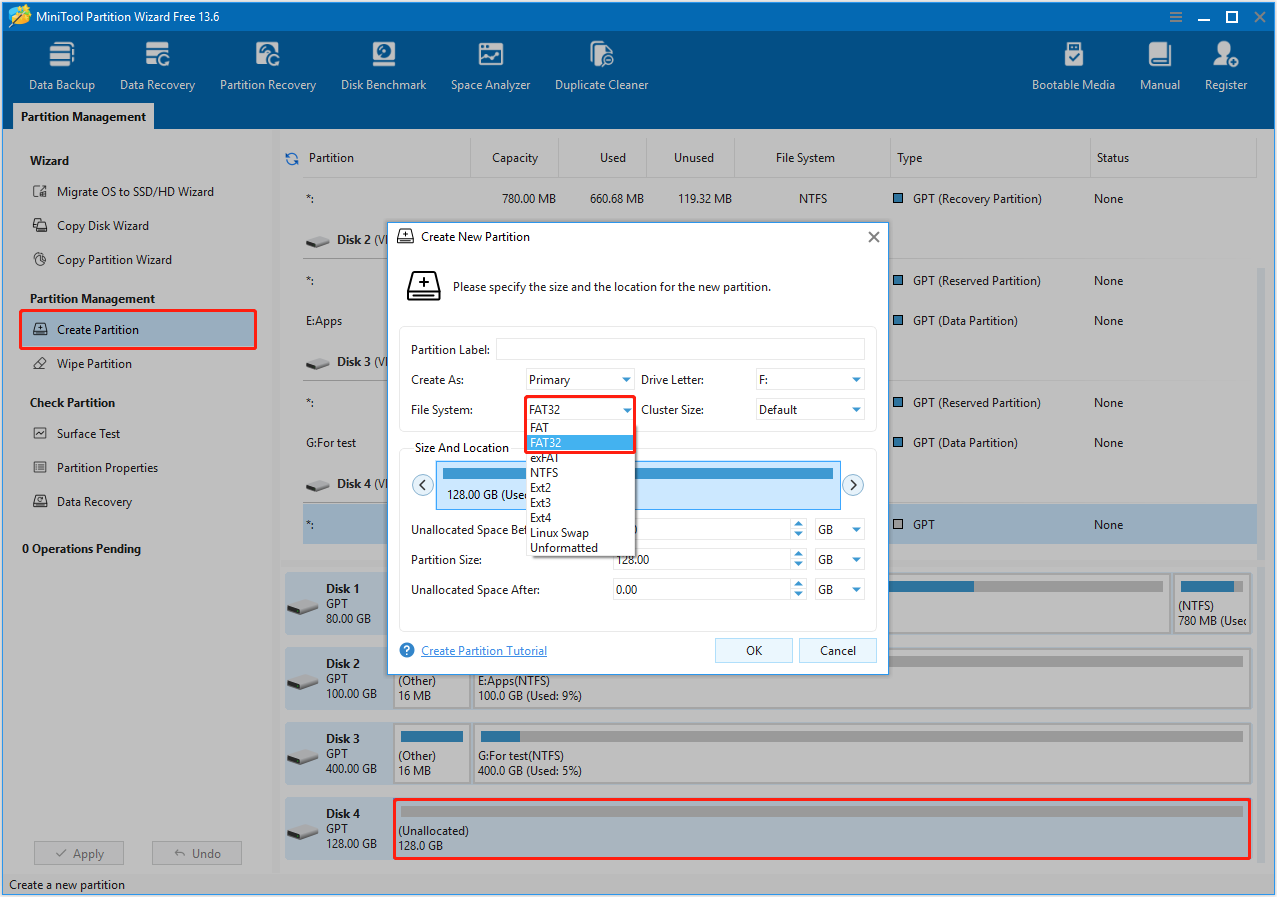
Step 3. Click Apply. After the process is complete, the 128GB disk will be partitioned to the FAT32 file system and ready to use.
If this guide helped you learn how to format 128GB SD card to FAT32, share it on Twitter to help others having the same question.
Bottom Line
Formatting a 128GB SD card to FAT32 on Windows is possible, even though File Explorer and Disk Management do not provide the FAT32 option.
If your device requires FAT32, use a free formatter such as MiniTool Partition Wizard.
Should you have any questions or encounter any bugs when using MiniTool products, please contact the technical support team at [email protected].
Format 128GB SD Card to FAT32 FAQ
Step 1. Select the NTFS partition and click Convert NTFS to FAT from the left sidebar.
Step 2. Click Apply > Yes to apply the change.
However, Windows built-in tools like File Explorer and Disk Management do not offer FAT32 for drives larger than 32GB.
To do this, you need third-party tools such as MiniTool Partition Wizard, Rufus, or GUIFormat.
These tools can bypass the Windows formatting restriction.
Method 1. Format the SD card to FAT32 using a FAT32 formatter (removes all files on the card).
Method 2. Convert the existing file system to FAT32 by using MiniTool Partition Wizard (preserves existing files).
About The Author

Position: Columnist
Shirley holds a bachelor’s degree in English and has been an editor at the MiniTool Team for many years. She specializes in IT-related content, with a focus on data recovery, file backup, disk management, and other technical topics. She is committed to delivering clear, accurate, and practical solutions to help users resolve common computer issues.
User Comments :