
Storage space has always been a concern. As the most common form of extended storage, microSD cards have seen a leap from a few hundred MB to several TB.
This article will explore the largest microSD cards currently on the market. It includes the applications, future development trends, key points when buying, and common microSD brand comparisons.
An Introduction to microSD Cards
A microSD card is an ultra-small, removable flash memory card, a scaled-down version of the SD (Secure Digital) standard. It measures only 15mm × 11mm × 1mm, about a quarter the size of a regular SD card.
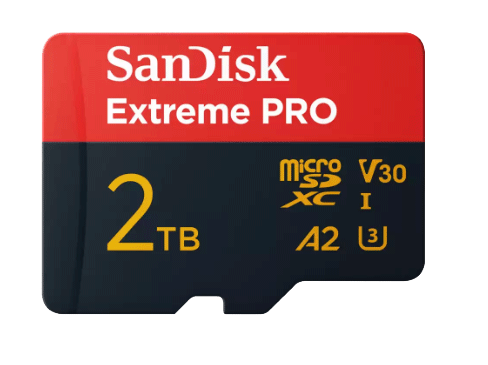
Source: https://shop.sandisk.com/
They are commonly used to expand the storage space of smartphones, drones, gaming devices, and cameras.
The microSD cards are more versatile because they typically come with an SD adapter, allowing them to be used in hardware devices that only support SD cards.
The microSD cards are mainly divided into these capacity specifications: microSD (≤2GB), microSDHC (≤32GB), microSDXC (≤2TB), and the latest microSDUC (≤128TB).
What are the largest capacity microSD cards currently on the market? The answer will be revealed below.

Overview of Maximum-Capacity microSD Cards
This section explains the features, advantages, disadvantages, and applications of the large-capacity microSD cards.
Features of the Maximum-Capacity microSD Cards
The largest microSD cards are very popular. Here are some of their features to help you better understand them.
- Massive capacity: The largest microSD card capacity reaches 2TB, equivalent to storing the data on approximately 400 DVDs.
- High-speed transmission: High-capacity cards typically support UHS-II or UHS-I standards, and some models are even compatible with V30/V90 video rate classes. It can meet the needs of 4K or 8K video recording.
- Wide compatibility: Despite their enormous capacity, they maintain the small size of microSD cards. This makes them suitable for devices such as smartphones, tablets, cameras, drones, and game consoles.
- High price: Due to technology and manufacturing costs, these cards are significantly more expensive than regular-capacity microSD cards. Market demand and the allocation of storage chip resources also lead to greater price fluctuations.
Advantages and Disadvantages of Large-Capacity microSD Cards
Here are some advantages and disadvantages of the largest microSD cards.
Advantages:
- Large storage capacity reduces the hassle of frequent card replacements.
- Most modern devices support high-capacity microSD card expansion.
- It can accommodate more mobile applications and game data.
Disadvantages:
- It is expensive.
- The risk of data loss is high; damage could result in the loss of hundreds of GB or even TB of data.
- Some devices cannot recognize very high-capacity cards.
Applications of Large-Capacity microSD Cards
When and where are large-capacity microSD cards needed? Understanding their practical application scenarios enables you to use them more effectively.
- Professional photography and video creation. The largest microSD cards offer massive storage space, easily saving thousands of RAW photos or hours of 4K/8K video footage. This reduces the need for frequent memory card changes and ensures continuity during shooting.
- Gaming and entertainment devices. On devices like the Nintendo Switch, the microSD let players store and play multiple big games. They are also suitable for storing VR/AR content and complete sets of music, movies, and TV series.
- IoT devices. The largest capacity microSD cards provides local data storage for IoT (the Internet of Things) devices. This allows them to continue recording data even when the network is unstable or offline.
- Research and industrial applications. In research and industrial settings, devices such as drones, robots, and sensors generate massive amounts of data. The microSD cards, serving as portable storage media, help quickly save and transfer data.
How to Choose the Large-Capacity microSD Card
After learning about the basic information of this card, this section will introduce the selection criteria and comparisons of different brands.
Key Considerations When Buying a microSD Card
The following key considerations guide you to choose a suitable microSD card.
- Capacity compatibility: Confirm whether your device supports ultra-large capacity cards such as 1TB or 2TB.
- Speed class: Choose a speed class that suits your needs, such as V30 or higher for 4K/8K video.
- Brand reliability: Prioritize well-known brands like SanDisk and Samsung to avoid low-quality products.
- Authenticity verification: Purchase through official channels to avoid buying counterfeit cards with falsely advertised capacities.
- Price factors: Consider your budget and actual needs because the ultra-large capacity cards are expensive.
- Future suitability: Consider device upgrades and long-term usage scenarios to avoid buying cards that you cannot fully utilize.
Common Large-Capacity microSD Card Comparisons
The following chart provides a direct comparison of the capacity, read/write speed, price, and application scenarios of some common brands.
| Capacity | Typical Read Speed | Typical Write Speed | Price | Best Use Case | |
| SanDisk (SanDisk Extreme PRO microSDXC UHS-I CARD) | 2TB | 250MB/s | 150MB/s | $300-450 | Professional photography, 4K/8K video recording, and drones |
| Kingston (Canvas Go! Plus microSD memory card) | 1TB | 200MB/s | 160MB/s | $100-150 | 4K video recording, drone aerial photography, surveillance equipment, and extended storage for mobile phones or handheld devices. |
| Samsung (PRO Plus 1 TB microSDXC Card UHS-I + Adapter) | 1TB | 180MB/s | 130MB/s | $120-150 | Handheld games (Switch/Steam Deck), 4K video, daily expansions |
| Lexar (BLUE microSDXC UHS-I Card) | 2TB | 205MB/s | 140MB/s | $120-230 | Gaming equipment, creators’ daily photography |
| TeamGroup (PRO+ Micro SDXC UHS-I U3 A2 V30 Memory Card) | 2TB | 160MB/s | 110MB/s | $120-130 | 4K video shooting, drones, handheld console expansion |
After checking this chart, choose a brand that suits you most.
What Are the Future Development Trends of microSD Cards
The development of microSD cards is inextricably linked to the evolution of the SD standard. Future microSD cards will evolve towards larger capacities, higher speeds, and greater compatibility.
With the introduction of the SDUC standard, theoretical capacities can reach 128TB. The next-generation SD Express technology introduces PCIe/NVMe interfaces, significantly improving transfer speeds. This meets the demands of 8K video, AR/VR content, and edge computing.
Meanwhile, future cards will place greater emphasis on data security and durability to address the risks associated with centralized storage.
They will also play a more significant role in IoT, drones, and high-performance mobile devices.
MiniTool Power Data Recovery FreeClick to Download100%Clean & Safe
Final Words
Now you may have a better understanding of the largest microSD cards. Knowing about their features, advantages, disadvantages, practical application, capacity, read/write speed, and price is necessary. That enables you to use them more efficiently.
If you have any questions about the MiniTool product, feel free to contact us at [email protected].
User Comments :