
Dash cams have become essential tools for road safety, recording important footage in case of accidents, traffic violations, or disputes.
However, a common and frustrating issue you may face is the dash cam not recognizing the SD card, whether it’s new, previously working, or suddenly unreadable.
We outline six solutions to resolve the “dash cam not detecting SD card” problem.
Before proceeding to the fixes, it’s critical to understand why your dash cam fails to recognize the SD card.
Why Is Your Dash Cam Not Recognizing/Detecting/Reading SD Card
Here are the most common culprits for the “dash cam not reading SD card” issue:
- Improper Seating: The SD card may not be fully inserted in the dash cam’s slot.
- Incorrect Card Type: Dash cams need high-speed SD cards for 4K/8K recording; using lower speed cards can cause issues.
- Outdated Firmware: An outdated firmware of the dash cam can lead to misinterpretation of the SD card, causing detection errors.
- Corrupted File System: If the SD card’s file system is corrupted due to sudden power loss, improper ejection, or virus infection, the dash cam may fail to recognize it.
- Faulty Card Slot: Frequent insertions and removals can wear out the dash cam’s card slot, preventing card detection.
- Damaged SD Card: Exposure to extreme temperatures, water damage, or physical bending can render the card unrecognizable.
Initial Step: Recover Files from the Unrecognized SD Card on Windows
Before attempting any fixes that may modify the SD card, such as formatting or reseating it, first recover data from the unrecognized SD card.
Insert your SD card into the PC, and several situations may happen on your SD card when the dash cam does not recognize it:
- Situation 1. Your SD card can be detected and read by Windows. In this situation, transfer your files to another drive before fixing the issue.
- Situation 2. Your SD card can be recognized, but can’t be read by Windows. In this case, you need to recover your SD card data before formatting it.
- Situation 3. Your SD card can be read by Windows, but the files are lost. In such a situation, use a professional data recovery tool to recover data before fixing the card.
- Situation 4. Your SD card can’t be detected by both the dash cam and Windows. In this scenario, your SD card may be severely damaged. Try having it repaired by a professional or consider getting a new card.
For reliable data recovery on Windows 11/10, MiniTool Power Data Recovery is the ideal solution.
It’s designed to recover lost, deleted, or inaccessible data from various storage devices, including SD cards, USB drives, hard drives, and other storage media.
Below are some main features of MiniTool Power Data Recovery:
- High Success Rate: Advanced scanning algorithms can recover files from corrupted, formatted, or damaged SD cards.
- Wide Compatibility: Supports all SD card formats, like FAT32, exFAT, and NTFS, and dash cam file types, including MP4, MOV, AVI, and so on.
- User-Friendly Interface: No technical skills required. Even beginners can follow the steps to recover dash cam footage.
- Safe & Secure Data Recovery: Does not modify the original data on the SD card during the recovery process, ensuring no further damage.
- Free Edition: This free data recovery software allows you to recover 1GB of files for free.
Now, download and install this tool on your PC to recover SD card data on Windows.
MiniTool Power Data Recovery FreeClick to Download100%Clean & Safe
Here’s how to recover data from an unrecognized SD card using MiniTool Power Data Recovery on Windows:
Step 1. Scan the Target Partition
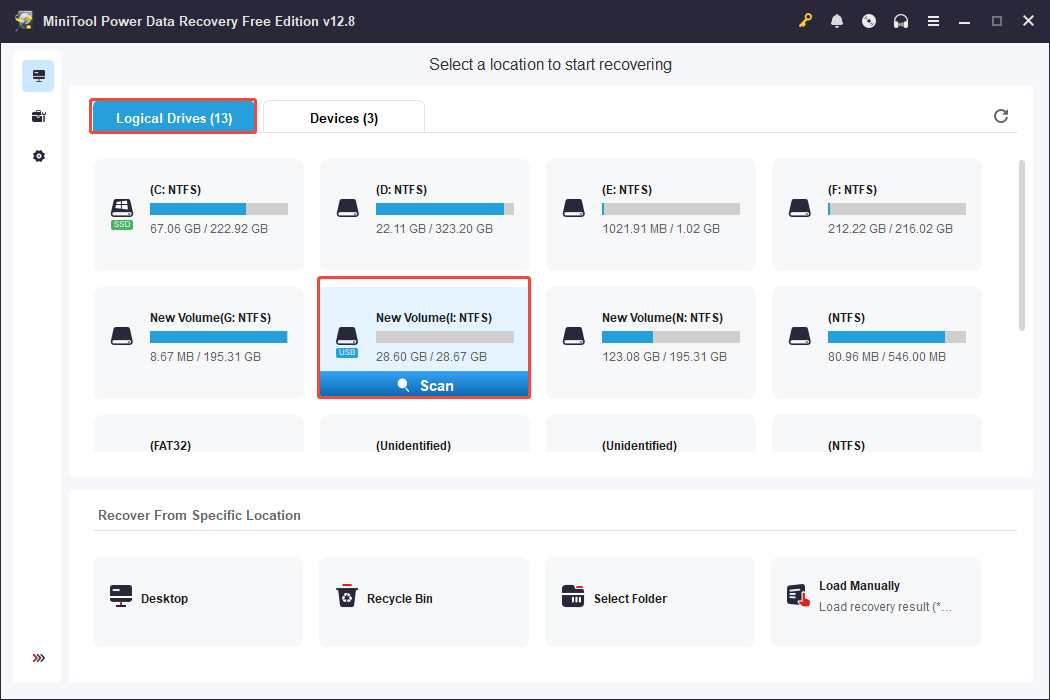
Open MiniTool Power Data Recovery. All file storage devices detected by your PC will be displayed on the main interface of the recovery tool.
Under the Logical Drives tab, select your SD card with a USB icon and click Scan.
Step 2. Locate and Preview the Wanted Files
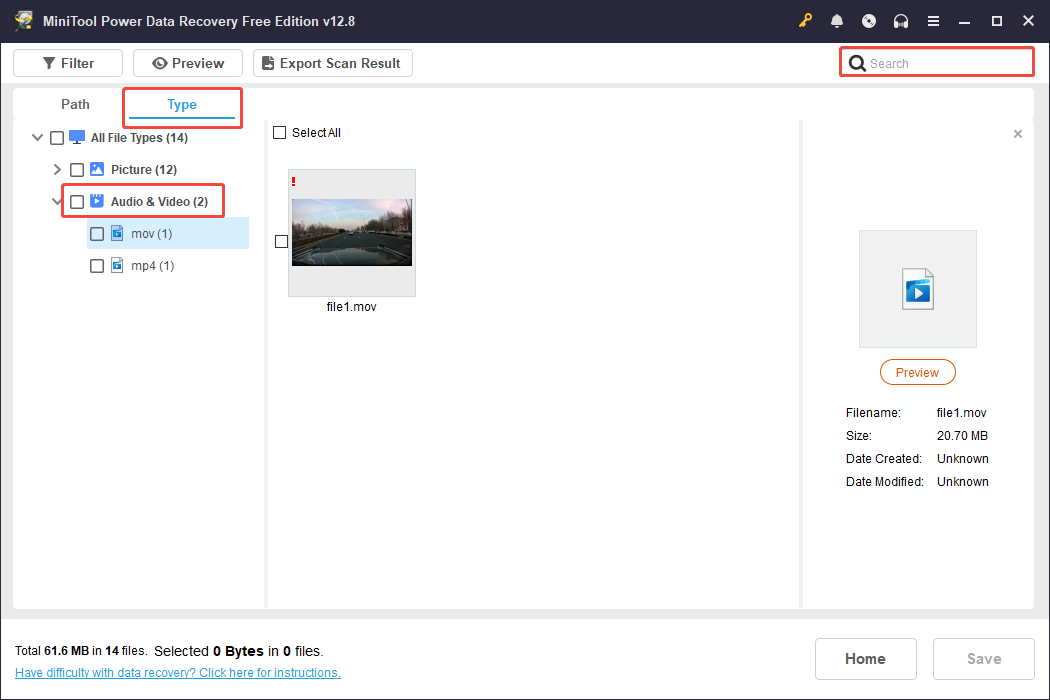
After the scan completes, go to Type > Audio & Video to find your dash cam recordings. In addition, type the file name in the Search box and press Enter to locate the specific file.
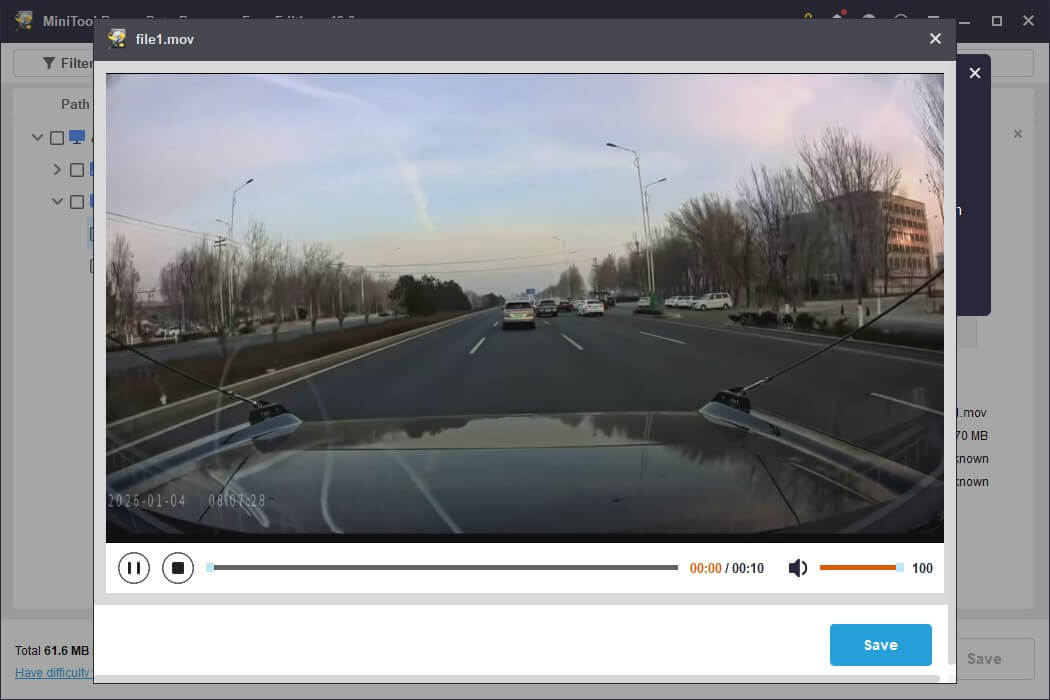
To verify if the file is needed, double-click to preview it.
Step 3. Save the Desired Files
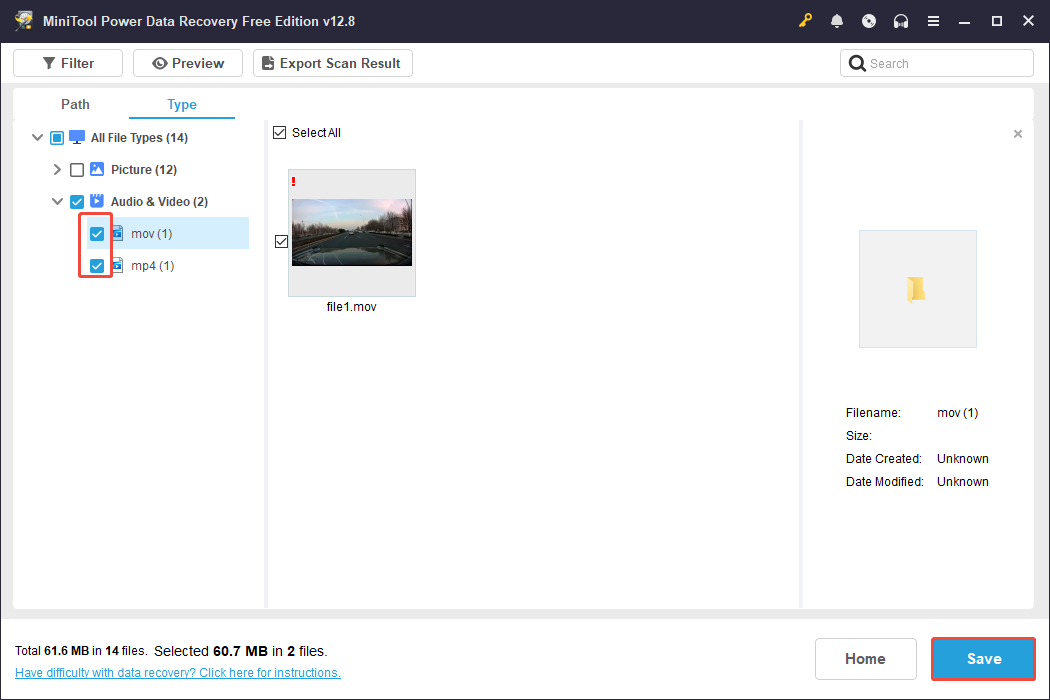
Select the files you want to recover and click Save. In the pop-up window, choose a safe location on your PC’s hard drive (not the SD card) to save the recovered data.
How to Fix the Dash Cam Not Recognizing SD Card
Once you’ve recovered your important files, proceed with the following fixes to resolve the “SD card not recognized” issue.
We’ve ordered these methods from simplest to most advanced, including:
- Solution 1. Re-insert the SD card.
- Solution 2. Check the lock switch.
- Solution 3. Clean contacts.
- Solution 4. Update the dash cam firmware.
- Solution 5. Format the SD card.
- Solution 6. Use a new SD card.
Read on to try these methods one by one until your SD card’s problem is fixed.
Method 1. Re-Seat the Card
Sometimes, the driving vibrations may cause the loose connections between the SD card and the dash cam.
In this case, reconnecting the SD card is the easiest fix:
- Turn off the Dash Cam: Make sure the dash cam is completely powered off to prevent any potential data corruption when removing the card.
- Remove the SD Card: Carefully pull the SD card out of the card slot. If the card is stuck, don’t force it, and check for any obstructions.
- Re-Insert the Card Securely: Align the SD card with the slot and push it in until you hear a click. Make sure the card is fully seated. No part of the card should be sticking out.
- Verify the Dash Cam: Turn on the dash cam and check if it recognizes the SD card.
If the dash cam still does not detect the card, proceed to the next solution.
Method 2. Check the Lock Switch
If your SD card has a physical lock switch, accidentally enabling the lock switch is a common cause of read and write restrictions.
Here’s how to check it and unlock the card:
- Locate the Lock Switch: Find the small sliding switch on the left side of the SD card (standard size) or microSD card (in the adapter).
- Unlock the Card: Slide the switch to the “unlocked” position (away from the padlock icon). If the switch is already unlocked, briefly switch it to the locked position, then back to unlocked to reset.
- Reinsert the Card: Put the SD card back into the dash cam and test detection.
If the SD card detection issue persists, move to the next part.
Method 3. Clean Contacts
As mentioned above, dirty or corroded contacts may trigger the detection failures, especially in dash cams exposed to dust or humidity.
Therefore, consider cleaning the contacts on the SD card and the dash cam’s card slot. Follow these steps:
- Gather Materials: You’ll need a soft, dry microfiber cloth for general cleaning, 70% isopropyl alcohol, and a cotton swab for hard-to-reach areas.
- Clean the SD Card Contacts: Carefully wipe the gold metal contacts on the SD card using the microfiber cloth. For tough grime, dampen a cotton swab with isopropyl alcohol and gently wipe the contacts.
- Dry the Contacts: Allow the contacts to air dry for 1-2 minutes to make sure no alcohol residue is left.
- Clean the Dash Cam Slot: If the dash cam’s card slot is accessible, use a dry cotton swab to remove dust from the slot contacts.
- Reinsert the Card: Put the cleaned SD card back into the dash cam and check if the dash cam detects it.
If the card still isn’t recognized, proceed to the following solution to update the dash cam firmware.
Method 4. Update Dash Cam Firmware
Outdated firmware may lead to compatibility problems with SD cards. In this case, updating the firmware can fix the “dash cam not recognizing SD card” issue.
Here’s how to do it:
- Visit the Manufacturer’s Website: Access the official site of your dash cam brand and look for the Support or Downloads section.
- Find Your Model: Find your dash cam’s model number, usually located on the bottom or in the user manual, and download the most recent firmware update.
- Prepare the SD Card: Format the SD card using Windows 11/10 and transfer the firmware file to the root directory of the SD card (do not place it inside a folder).
- Install the Firmware: Insert the SD card into the dash cam, turn it on, and follow the on-screen instructions to update the firmware. The dash cam will automatically recognize the firmware file and start the update process.
If the SD card is not recognized, use the manufacturer’s proprietary software like MyNextbase Player to update the firmware.
Method 5. Format the SD Card
Formatting the SD card can fix corrupted file systems, but it will delete all data. Therefore, ensure you’ve recovered your files first.
Before formatting, confirm the SD card is compatible with your dash cam. Refer to your dash cam’s user manual to confirm the supported SD card types.
Here are two solutions to format an SD card:
Option 1. Use Disk Management
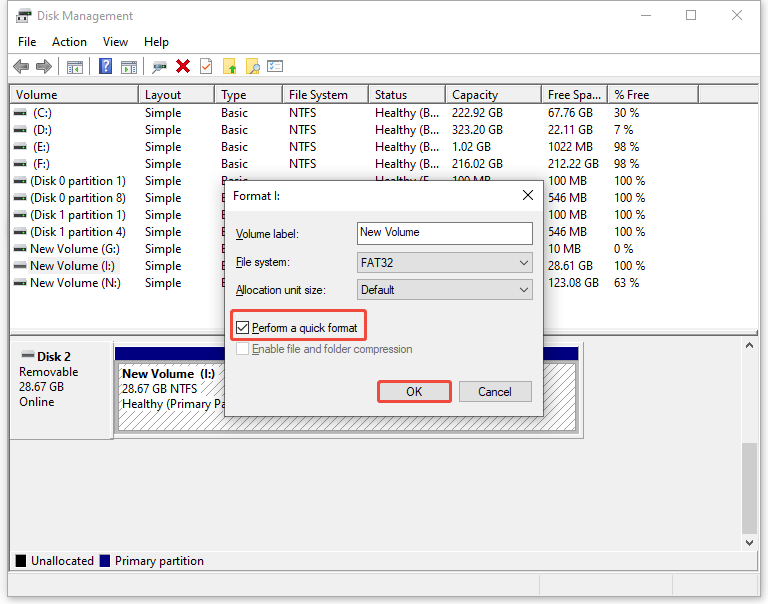
- Insert your SD card into your PC. Press Win + X to open the WinX menu and select Disk Management from the list.
- Find the problematic SD card in the list of disks, right-click on it, and choose Format.
- Type the volume label and select a suitable file system for the SD card. Ensure the Perform a quick format option is checked, then click OK to confirm your changes.
Option 2. Use MiniTool Partition Wizard
If your SD card is write-protected, you may not format it in Disk Management. In this scenario, opt for using a professional SD card formatter.
MiniTool Partition Wizard is the best software for formatting SD cards because it provides various file systems, including NTFS, FAT32, FAT, exFAT, Ext2/3/4, and more.
MiniTool Partition Wizard FreeClick to Download100%Clean & Safe
Additionally, its user-friendly interfaces and clear step-by-step wizards make it easy to follow all the steps.
To format your SD card using MiniTool Partition Wizard, follow these instructions:
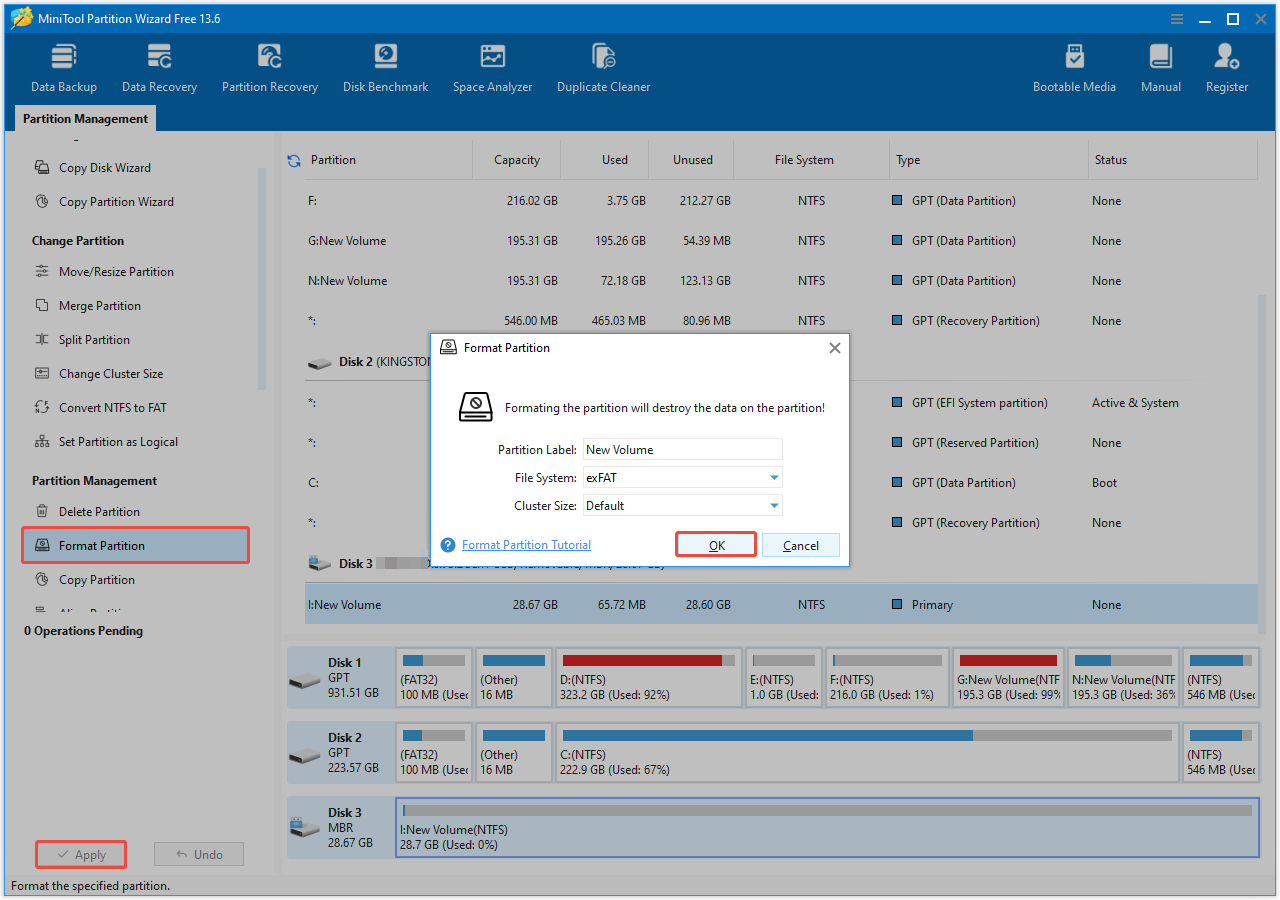
- Launch MiniTool Partition Wizard. Select the partition of the SD card and click Format Partition in the left action panel.
- In the pop-up window, select the file system, partition label, and cluster size. After making these choices, click OK to return to the main window.
- Click Apply to start the process of formatting the SD card.
Method 6. Replace the SD Card
If none of the above methods work, the SD card may be faulty or damaged. Dash cam footage requires high durability, so choosing a new high-quality card is crucial.
- Choose a Reliable Brand
- Select the Right Specifications
Insert the new SD card into the dash cam, power it on, and the dash cam will format it automatically. Test recording to ensure it works properly.
Bottom Line
The “dash cam not recognizing SD card” issue can be resolved effectively with practical methods.
Follow the outlined steps, beginning with re-inserting the card, checking the lock switch, cleaning the contacts, updating the firmware, formatting, or replacing it.
Recover your data first using MiniTool Power Data Recovery before trying any fixes that may delete files.
This powerful tool ensures you don’t lose critical accident footage or important recordings, even if the SD card is corrupted or unreadable.
If you need any help or have any questions when using MiniTool software, please send an email to the support team at [email protected].
User Comments :