
SD cards are widely used in everyday electronic products. However, many people use SD cards daily without fully understanding how they work.
This article will guide you through a deeper understanding of how SD cards work and what is an SD card used for.
What Is an SD Card?
An SD card (Secure Digital Card) is a small, removable storage device used to store various types of digital data.
It uses non-volatile flash memory technology, meaning that data is not lost even when power is off.
It comes in three physical sizes: standard SD card, miniSD card (now largely discontinued), and microSD card (the smallest model).
Furthermore, SD cards are classified into several standard sizes based on storage capacity:
- SD (Standard): Up to 2GB, generally obsolete.
- SDHC (Secure Digital High Capacity): 2GB – 32GB.
- SDXC (Secure Digital eXtended Capacity): 32GB – 2TB.
- SDUC (Secure Digital Ultra Capacity): 2TB – 128TB.
How Do SD Cards Work
SD cards may differ in form factor, interface, bus standard, or PCI channel, resulting in variations in appearance and performance.
However, regardless of speed, all SD cards are based on flash memory technology to store digital data.
They work by storing electrons in the grid of transistors using voltage, ensuring that data is retained even when power is off.
The core components of an SD card and their working principles are as follows:
- Flash Memory (NAND): As a storage medium, it stores data in binary form and performs data storage by changing the charge in transistors.
- Controller: The “brain” of the SD card, responsible for coordinating data transfer between the device and the flash memory, and handling error correction.
- Interface: The SD card connects to devices (such as cameras and mobile phones) via pins on the back, enabling data transfer.
- Non-volatile Storage: Unlike RAM, the SD card retains data even after power is off because its transistors are specifically designed to capture electrons.
- Data Processing: When writing data, the controller divides the data into blocks and pages, capturing electrons using voltage.
Now that the working principle of SD cards is understood, let’s see what is an SD card used for in different devices.
How Do SD Cards Work in Different Devices
Different devices have different requirements for the reading, writing, and storage methods of SD cards.
This means that the applications of SD cards are not limited to traditional data storage but also extend to high-speed data transfer, video recording, and many other fields.
Next, it will explore how to use SD card in different devices and delve into their specific working principles in different devices.
#1. Use SD Cards on Cameras
In cameras, the primary function of an SD card is to store captured photos and videos.
When the shutter button is pressed, the image sensor converts the light signal into a digital signal, which is then used by the image processor to generate an image file.
This data first enters the camera’s buffer and is then written to the SD card via an interface.
However, if the memory card’s read/write speed cannot keep up with the camera’s shooting speed, the buffer will fill up, causing the camera to pause recording.
At this point, the data must wait for the write process to complete before shooting can resume.
To avoid this situation, choosing the right SD card is crucial.
The SD card speed requirements for different cameras depend on the nature of the shooting task, such as continuous shooting or 4K/8K video recording.
Generally, most cameras require a minimum sustained write speed of 30MB/s (V30) for SD cards.
For high-speed continuous shooting or high-bitrate video recording, a memory card with a speed of 60MB/s to 90MB/s (V60/V90) is recommended.
#2. Use SD Cards on Laptops
SD cards are used in laptops as removable, non-volatile flash memory, enabling rapid expansion of storage or file transfer.
It can be inserted directly into the device’s built-in slot or connected via a USB adapter. The controller writes data to the NAND flash memory cells.
How SD cards work in laptops:
- Plug and Play: After inserting an SD card, the computer recognizes it as a removable storage device. You can find it in File Explorer (Windows) or Finder (macOS).
- Data Storage: SD cards store data in flash memory using electrical charge, ensuring data retention even when power is off.
- Controller: The controller within the SD card is primarily responsible for storing data in blocks.
#3. Use SD Cards on Consoles
SD cards are also widely used in game consoles, such as the Nintendo Switch, which supports expanding storage space via microSD cards.
So, how exactly do SD cards work in these consoles?
Simply insert the microSD card into the card slot at the back of the console’s kickstand, pushing it in until you hear a “click”. The system will then automatically recognize it.
When the SD card is inserted into the console, the console first identifies the card type and communicates with it via a storage protocol. Data is written to the SD card when downloading or installing games. When launching a game, the console reads the data from the SD card.
#4. Use SD Cards on Drones
SD cards are primarily used in drones to store photos and videos taken during flight. Here are some characteristics of drone SD cards:
- SD card insertion location: Drones typically use MicroSD cards. The card slot is usually located on the drone itself, but sometimes it’s also located in the remote controller.
- Speed requirements: To support high frame rate 4K video recording, high-speed storage cards are usually required, such as Class 10, UHS-I Speed Grade 3 (U3) cards.
- Capacity: Drones (such as DJI) typically use MicroSD cards. Common supported capacities are 64GB, 128GB, 256GB, and 512GB, with some high-end models even supporting 1TB and above.
#5. Use SD Cards on Dashcam
The SD card in a dashcam serves as an external storage device, primarily responsible for storing video files, images, etc. It writes new video files to the SD card during continuous loop recording.
Because dashcams need to continuously write high-definition video data, the SD card’s write speed is particularly important.
Generally, it is recommended to use a Class 10, U3, or higher SD card to ensure recording stability.
#6. Use SD Cards on Phones
SD cards can be used in mobile phones to expand storage space by providing removable flash memory, primarily for storing photos, videos, and files.
Simply insert the MicroSD card into the card tray or a dedicated slot under the back cover of your phone to start using it.
Here’s how SD cards work in Android systems:
An SD card can be used in a phone as portable storage or internal storage.
- Portable storage: Similar to a USB flash drive, this card can be used to store media files but cannot install applications.
- Internal storage: This card is formatted and encrypted and used as part of the phone’s internal storage. It can be used to install applications.
How to Format SD Card
Regardless of the device the SD card is used in, you may need to format it to ensure it functions correctly or meets specific needs.
For some devices, such as cameras or drones, you can format them directly on the device.
In other cases, you may need to use a computer to format the SD card. MiniTool Partition Wizard can help you format SD card.
MiniTool Partition Wizard is a free partition manager that can format SD cards to various file systems, including FAT32, NTFS, exFAT, and Ext2/3/4.
Notably, it supports formatting SD cards larger than 32GB to FAT32, which is extremely useful in many devices and systems.
This is because the FAT32 file system has broad compatibility, working with most cameras, drones, mobile phones, and other devices.
MiniTool Partition Wizard FreeClick to Download100%Clean & Safe
Step 1: Launch MiniTool Partition Wizard and go to the main interface.
Step 2: Right-click the SD card partition and choose Format.
Step 3: In the pop-up window, you can drop down the File System box and choose a file system (FAT32, NTFS, exFAT, or Ext2/3/4). Then click OK.
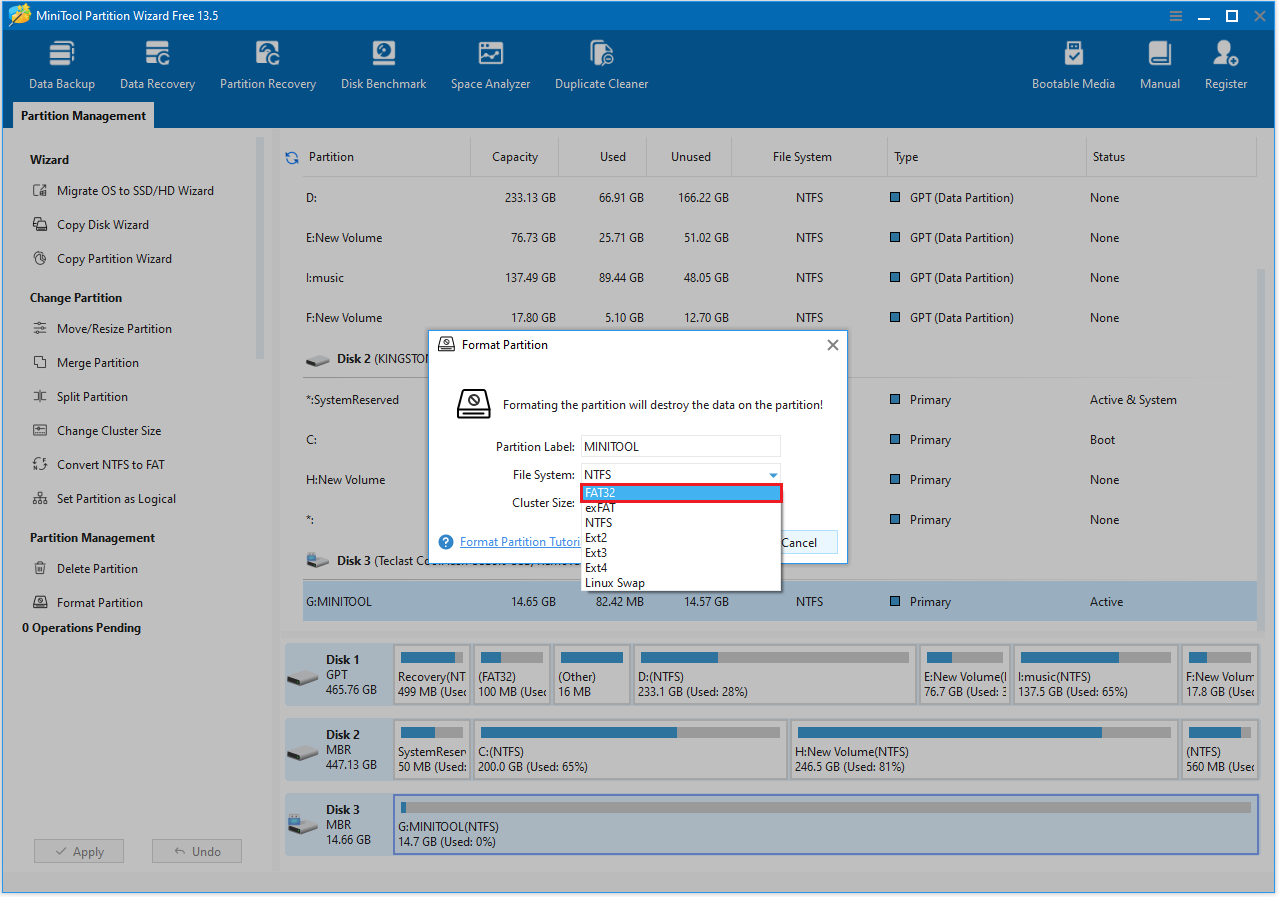
Step 4: You can see that the SD partition is set to have a FAT32 file system. To save all the changes, simply click the Apply button.
Common SD Card Problems and Solutions
Sometimes, SD cards may encounter problems such as data corruption, write protection, or accidental data deletion. Here are some common SD card problems and their solutions:
- SD card not recognized/detected: If the SD card is not recognized, first clean the metal contacts, try a different USB port or card reader, and check if the device driver needs to be updated.
- Corrupted or unreadable files: You can run Windows’ disk check tool (chkdsk) to repair errors in the file system.
- Write protection: Check the side of the SD card for a small locking switch. If present, switch it to the unlock position. When locked, you will not be able to write to or delete data on the SD card.
- Accidentally deleted data on the SD card: When data on an SD card is accidentally deleted, you can use the Data Recovery function of the MiniTool Partition Wizard to recover the data.
- Physical damage: If the SD card is physically damaged, such as being cracked, you may need to replace it with a new one.
This article explains how SD works and how to use it on different devices.Click to Tweet
How Do SD Cards Work FAQ
1. Back up your data regularly: Regularly back up important data from your SD card to other storage devices or the cloud to avoid data loss due to SD card damage.
2. Reduce frequent write operations: The flash memory cells of an SD card have a limited number of write cycles. Frequent writing of large amounts of data (especially small files) will accelerate card wear.
3. Avoid exposure to extreme environments: High temperatures, humidity, and other harsh environments can accelerate the aging process of an SD card and even lead to data corruption.
Improper removal of the SD card may result in data corruption. The safest practice is to use the safe eject option to properly remove the SD card.
Bottom Line
This article explains “how does an SD card work” and “how to use an SD card” on different devices. In short, an SD card uses a controller to handle data reading and writing, while the flash memory chip is responsible for storing the data.
If you have any questions or suggestions while using MiniTool Partition Wizard, contact us via [email protected] for further assistance.
User Comments :