
You can learn why the D drive is not accessible in this MiniTool article. It also provides practical fixes, such as taking ownership, reassigning a drive letter, updating the disk driver, running CHKDSK, and formatting it, to help you quickly restore access to the drive.
In Windows operating systems, the D drive is usually a second partition or another storage device, such as a second hard drive or SSD. Its letter “D” is the drive letter automatically assigned by the system to identify the storage area.
Issue: D Drive Is Not Accessible
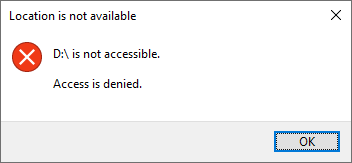
In daily computer use, the D drive is often used to store personal files, software installation packages, or backup data. If you get a “D:\ is not accessible. Access is denied” error when you double-click drive D, it’s not only confusing, but it may also indicate a data risk.
Why Is My D Drive Not Accessible
When you receive an error message like “D:\ is not accessible”, it typically means the system cannot read the partition. Here are some possible reasons for this issue.
- Insufficient permissions or incorrect ownership. If your account doesn’t have permission to access drive D, the system will deny access.
- File system corruption. A corrupted file system can cause hard drive errors, including inaccessibility.
- Bad sectors on the disk. Bad sectors, caused by physical damage or software errors, can make certain areas unreadable. This may render the D drive inaccessible.
- Driver or software conflicts. Certain drivers or security software may prevent the system from accessing the partition.
- Drive letter conflicts. If multiple partitions use the same drive letter, the system may not correctly identify drive D.
- Locked BitLocker encryption. If BitLocker encryption is enabled on drive D, you must enter a password or recovery key to access it.
For each of the causes listed above, there are solutions you can try to regain access to your D drive. However, in the process of solving this problem, data loss may occur. Therefore, you need to ensure the data security of the D drive.
Watch this video tutorial for a quick walkthrough:
First Aid: Recover Data from the Inaccessible D Drive
Since the D drive cannot be accessed, data transfer is difficult. At this time, consider using data recovery software to recover data from your inaccessible drive.
MiniTool Power Data Recovery is worth a try. This hard drive recovery tool can scan the inaccessible drive and supports recovery of nearly all file types.
To prevent any further data loss, the recovery process does not write to the original drive. In addition, the software’s clear interface makes the recovery easy, even without specialized knowledge.
This free data recovery software allows you to recover up to 1 GB of data for free. Download and install it now to recover your D drive data!
MiniTool Power Data Recovery FreeClick to Download100%Clean & Safe
Step 1: Scan the D drive
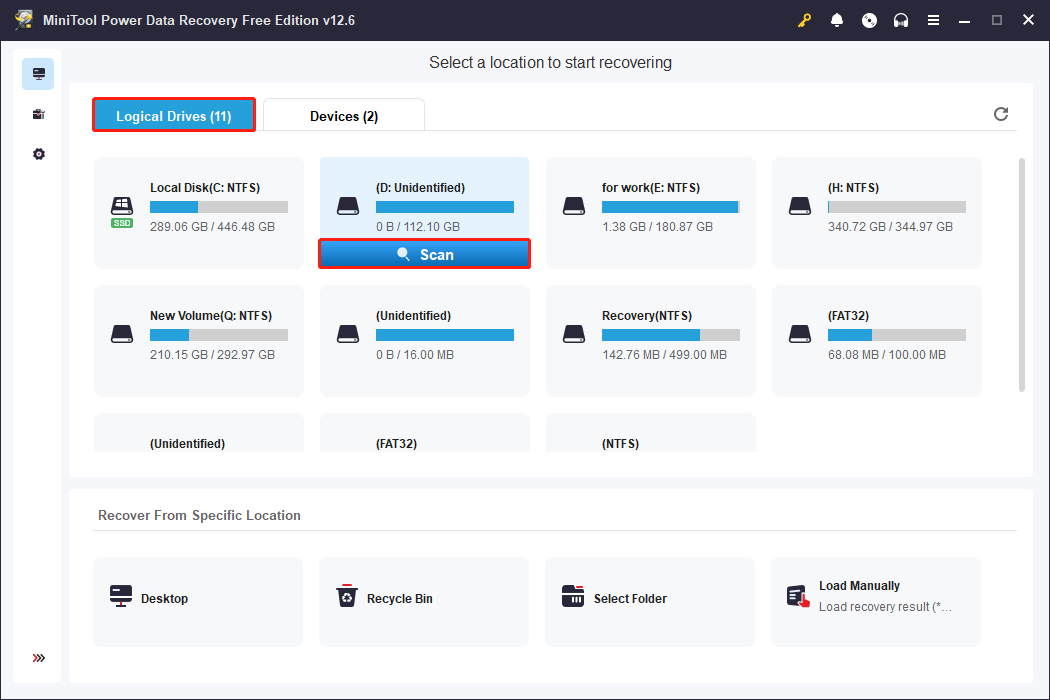
Launch MiniTool Power Data Recovery. Under Logical Drives, move your cursor to the D drive section and click Scan. The software will begin scanning the drive.
Step 2: Use Type, Filter, and Search to locate the target files
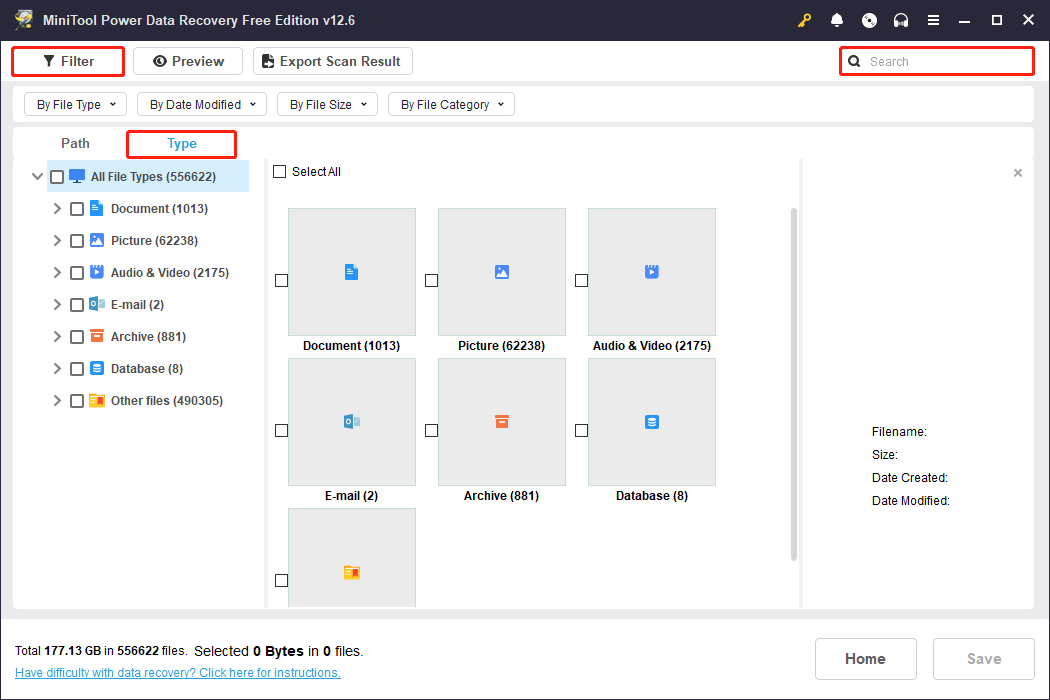
This scan process may take some time. When it ends, the files will be listed under Path. If you want to find files according to the file structure, find them in this section. Besides this, there are some other features to help you locate the files quickly.
- The Type feature supports finding files by file type. It categorizes discovered files into documents, pictures, audio, videos, etc.
- The Filter feature can further narrow down the scan results. You can filter target files by file type, modification date, file size, and file category.
- The Search feature allows you to directly enter a file name or keyword to find a specific file in the scan results accurately. It supports fuzzy matching and exact matching.
Step 3: Preview the file before recovery
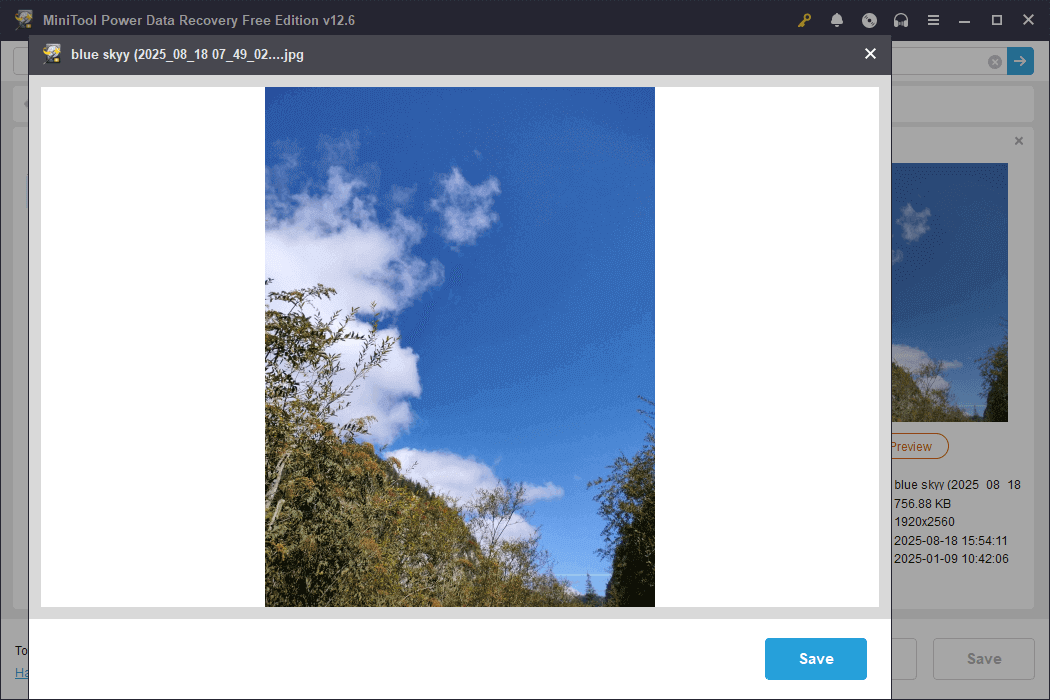
After finding the files, preview them to make sure they are correct. This can improve recovery efficiency and avoid unnecessary data recovery operations. MiniTool Power Data Recovery’s preview feature supports previews of various file types, such as pictures, documents, and videos.
Select the file you want to check and click the Preview button. The software will pop up a preview window to display the contents of the file.
Step 4: Save the selected files to a new location
Finally, tick all the desired files and click Save. In the directory window, choose a location for the recovered files and click OK.
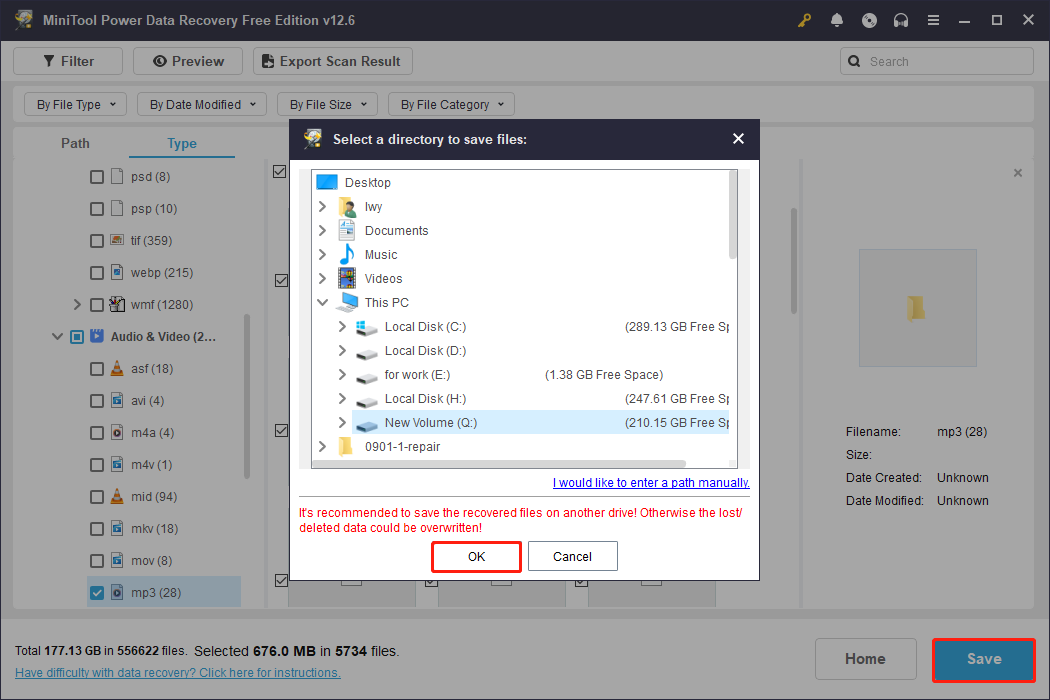
Once you see the Recovery Completed window, go and check your files. When the free recovery capacity is exhausted, you can upgrade to a full edition.
How to Fix D Drive Is Not Accessible
Now, it’s time to fix your inaccessible D drive with the following methods.
Fix 1: Take Ownership of the D Drive
Lack of permissions can make drive D inaccessible. Taking ownership of the drive can help you regain control. This operation allows you to add access permissions and restore the ability to read and manage data.
Step 1: Press Win + E to open File Explorer.
Step 2: Click This PC, right-click the D drive, and choose Properties.
Step 3: Switch to the Security tab and click the Advanced button.
Step 4: In the new window, click Change.
Step 5: In the pop-up small window, type Everyone in the text box and click OK.
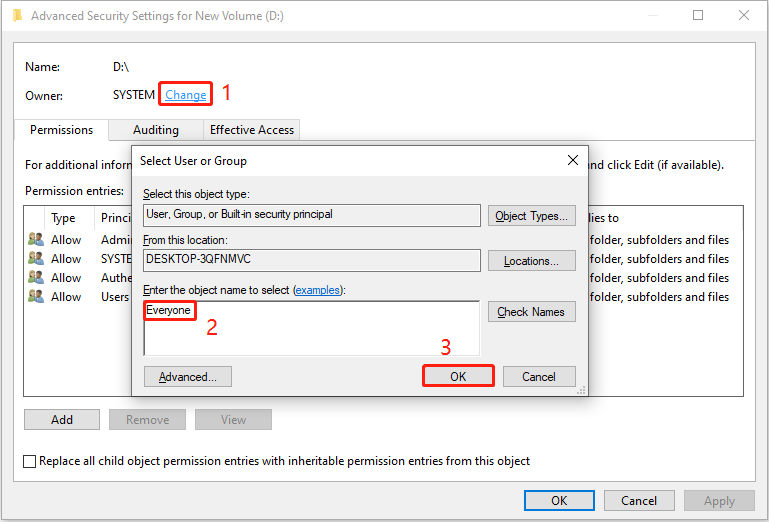
After adjusting permissions, go and check if you can access the D drive. If it is still inaccessible, the ways below may help.
Fix 2: Reassign a Drive Letter
Drive letter conflicts or system errors may render drive D inaccessible. Reassigning a drive letter can sometimes help the system re-identify the partition and restore normal access to data.
Step 1: Right-click the Windows button and choose Disk Management.
Step 2: Find your D drive, right-click it, and select Change Drive Letter and Paths.
Step 3: In the pop-up window, click the Change button.
Step 4: Choose an unused letter from the Assign the following drive letter menu.
Step 5: Finally, hit OK > Yes to confirm the change.
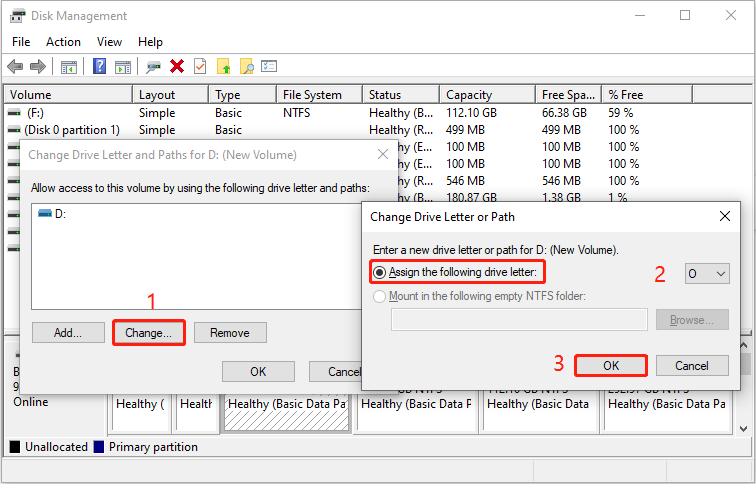
If this method fails, try the following fixes.
Fix 3: Update the Disk Driver
Outdated, damaged, or incompatible drivers can also cause recognition issues, which can be resolved by updating the disk driver. This operation will help the system correctly recognize the hard disk partitions again and restore access to the D drive.
Step 1: Press Win + X and choose Device Manager.
Step 2: Expand Disk drives, right-click your disk where the D drive is located, and choose Update driver.
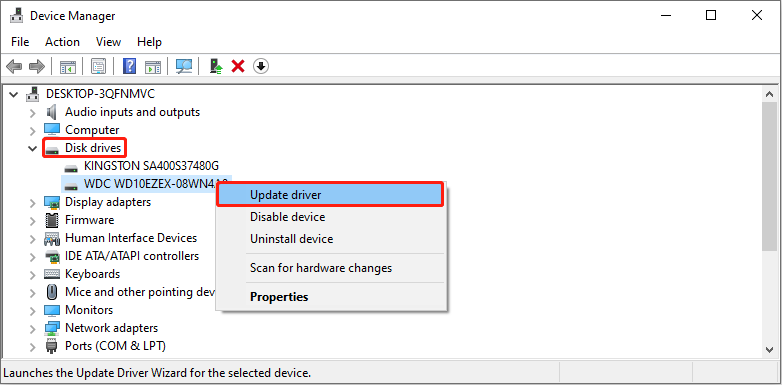
Step 3: In the new window, select Search automatically for drivers.
It will automatically detect if there is a new driver available. If there is, follow the prompts to complete the operation.
Still cannot access your D drive? Continue with the next way.
Fix 4: CHKDSK Your D Drive
When the D drive is not accessible, running the CHKDSK command is a key step. It can detect and repair issues such as file system corruption, bad sectors, or abnormal directory structures.
Step 1: Type cmd in the Windows search bar, right-click Command Prompt, and choose Run as administrator.
Step 2: When the UAC window prompts, click Yes to continue.
Step 3: Type chkdsk /f /x D: in the window and press Enter.
The system will begin checking the D drive and resolve any problems found. What if the D drive still cannot be accessed? Try the last resort.
Fix 5: Format the Drive to Normal
Formatting a drive is a last resort when other repair methods have failed. This operation clears damaged file system structures, misconfigurations, or potential viruses. It will reset the drive to a usable state and reestablishes a clean storage environment.
Disk Management is a built-in tool on Windows. It is used to manage hard disks and partitions. You can use it to quickly format the D drive.
While formatting erases all data, you’ve already recovered important data. So there’s no need to worry about that. Follow the steps to format the drive to normal right now.
Step 1: Open Disk Management, right-click the D drive, and choose Format.
Step 2: Type a new volume label, choose a file system, and click OK continuously.
After the formatting is complete, check whether the D drive can be used normally.
Don’t stop reading here. Continue reading the following precautions to protect your D drive.
How to Protect Your D Drive in the Future
Here are some measures you can take to protect your hard drive.
- Back up your data regularly. Regular backups are one of the most effective ways to protect your data. You can use an external hard drive, NAS, or cloud storage service to copy important files to multiple locations.
- Run disk checks regularly. Using CHKDSK to check your hard drive’s health can help identify some potential issues. Fixing them promptly can help extend your hard drive’s lifespan and prevent data loss.
- Install and update antivirus software. Viruses and malware can damage the file system on your hard drive. Install reliable antivirus software and keep it up to date. This will effectively prevent viruses from invading and protect the data.
Final Words
When your D drive is not accessible, remember to use MiniTool Power Data Recovery to recover data from it in advance. After that, try taking ownership, reassigning a drive letter, updating the disk driver, running CHKDSK, or formatting it.
If you have any questions about MiniTool products, please ask us for help through [email protected].
User Comments :