
Based on when and how the folder deletion took place, you can restore a deleted folder by utilizing Windows built-in features or data recovery software to get it back. Read on this MiniTool post to learn how to recover deleted folders on Windows.
As folders serve as organizational tools for categorizing different kinds of files, you may like using folders to store your files on your computer.
However, folders are not immune to accidental deletions or losses just like files.
When you accidentally delete a folder, the consequences are more significant as you are deleting several files simultaneously rather than just one.
If you are in the same situation as the user below, this post may be what you need.
“I was cleaning up my desktop just yesterday, and I accidentally deleted one of my folders containing my artwork files because I thought the folder I deleted on my desktop was a shortcut, but it wasn't. I've already emptied the Recycle Bin, so I'm just lost. I had so many files in there that I was hoping I could recover.”reddit.com
Don’t worry!
There are still opportunities to recover lost folders. But, before diving into the specific solutions, you may want to know what causes the folder deletion or loss.
Common Causes of Folder Loss
Accidental deletion of folders can happen for various reasons, often stemming from typical user actions and occasional technical issues. Here are some common situations:
- User Mistakes: A major cause is human error. This might involve mistakenly clicking Delete instead of another adjacent button or using keyboard shortcuts like Ctrl + X and then neglecting to paste before closing a program, resulting in unintended data loss.
- System Failures: Windows is generally stable, but it can occasionally experience unexpected system failures. When this occurs, open folders and files may not be properly saved, causing loss or corruption.
- Software Issues: Sometimes, programs may freeze or act unpredictably. These glitches can lead to unsaved work or even deleted files if the application corrupts data paths or mishandles open files during a crash.
- Virus and Malware Infections: Malicious software can disrupt your system, either intentionally or inadvertently deleting files.
- Etc.
As you can see, there are many situations that can lead to folder loss.
In the next part, we’ll answer your most pressing question: “Can I recover deleted folders?”
Is It Possible to Recover Deleted Folders on Windows 10/11?
Yes, you can recover deleted folders on Windows.
The good news is that when you delete a folder, it doesn’t disappear forever immediately. The physical data stays on your hard drive until that space is required for new files and is eventually overwritten.
But what occurs when you delete a folder? Keep reading to get more details.
What Happens When You Delete a Folder?
There are two types of deletion: temporary and permanent. The method used to delete folders on Windows influences your chances of recovering them.
Therefore, it’s crucial to differentiate between temporary and permanent deletion to understand your recovery choices.
Option 1. Temporary Deletion
When you delete a file using the “Delete” key or by dragging it into the Recycle Bin, it is not permanently deleted from your hard drive right away. Instead, it is moved to the Recycle Bin.
As long as the Recycle Bin hasn’t been emptied, the file can be recovered.
Option 2. Permanent Deletion
Utilizing the “Shift + Delete” shortcut or using third-party cleaning tools, as well as performing a full system format, causes the file to bypass the Recycle Bin and be immediately marked for deletion by the operating system.
This is known as a permanent deletion, as Windows removes the pointers to the data on the disk, freeing up space for new files.
To recover such files, you need professional data recovery software that can search the disk for remnants of the deleted data that haven’t yet been overwritten by new files.
How to Recover Deleted Folders on Windows 10/11?
Without further ado, let’s dive into the methods to recover lost or deleted folders on Windows.
This video guide provides clear and intuitive instructions about how to recover deleted or lost folders on Windows you can follow:
Method 1. Undo the Deletion
If you realize the deletion right away, the “Undo Delete” feature on Windows provides a quick and effective method to recover your folder.
It will restore the deletion if the folder was among the most recent actions taken.
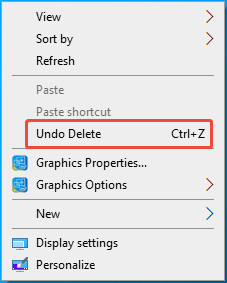
To recover deleted folders using the Undo Delete feature, press Ctrl + Z on the location where your deleted folder is stored.
Alternatively, you can right-click in the original location of the folder and select the Undo Delete option.
For example, if your deleted folder is stored on the desktop, right-click the space and choose Undo Delete from the context menu.
Nothing happen? Try checking the first place for deleted folders – the Recycle Bin.
Method 2. Check the Recycle Bin
As stated in the prior section, if you have deleted a folder on a temporary basis, you can conveniently retrieve it from the Recycle Bin.
Here’s how to recover deleted files from the Recycle Bin:
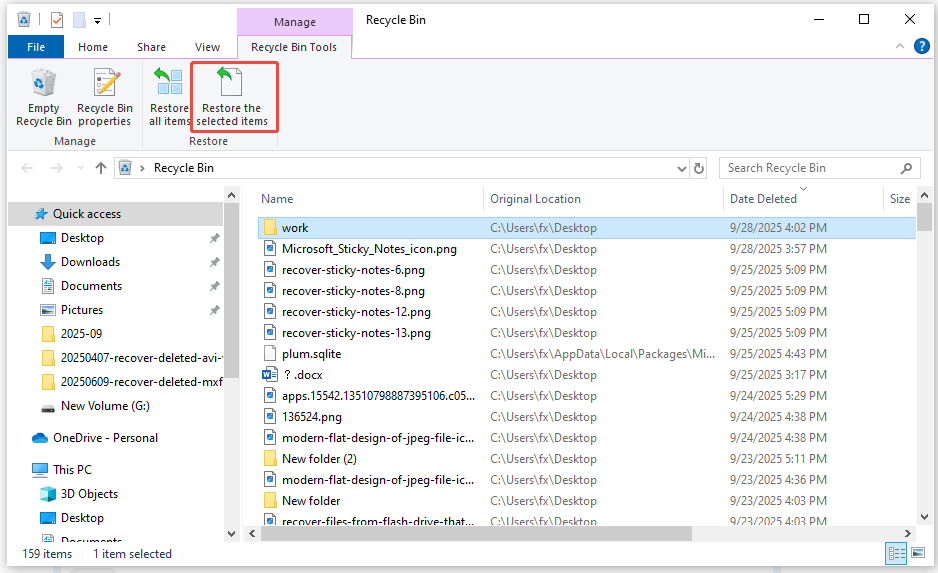
Step 1. Double-click the Recycle Bin icon on your desktop.
Step 2. Locate the folder, right-click on it, and select Restore from the context menu.
Alternatively, you can click on the Restore the selected items option at the upper left. The recovered folder will be saved in the original location.
Don’t find your deleted folder in the Recycle Bin? Go to the next method to try to recover it using Windows backup.
Method 3. Use File History
File History is a built-in feature of Windows that saves snapshots of your files and folders at regular intervals.
If you’ve enabled File History, it will automatically create backups of all your library files and folders (such as Documents, Music, Pictures, Videos, and Desktop), ensuring that any sub-folder removed from these areas is saved.
Follow the instructions to recover deleted folders using File History:
Here, we will show you how to recover a deleted folder from the desktop as an example.
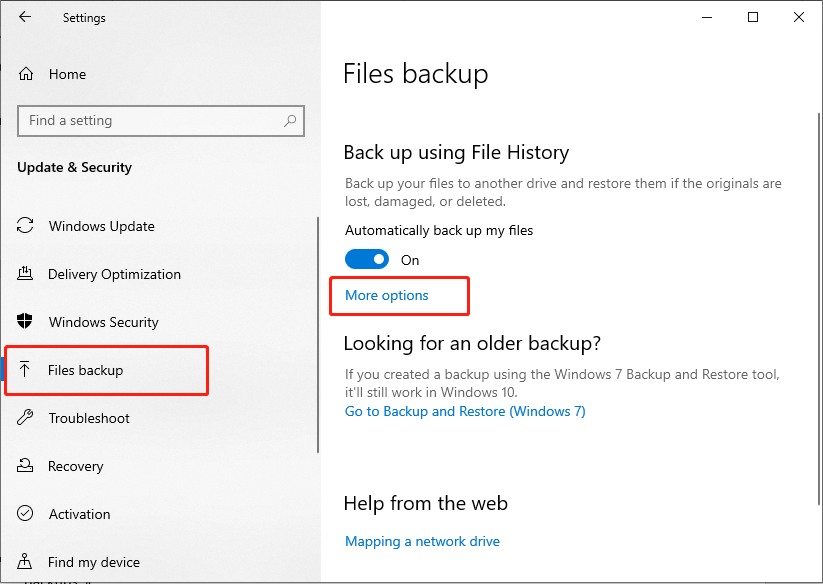
Step 1. Press Win + I to open Settings. Navigate to the following path: Update & Security > Files backup.
Step 2. Then you can click the More options link under Back up using File History.
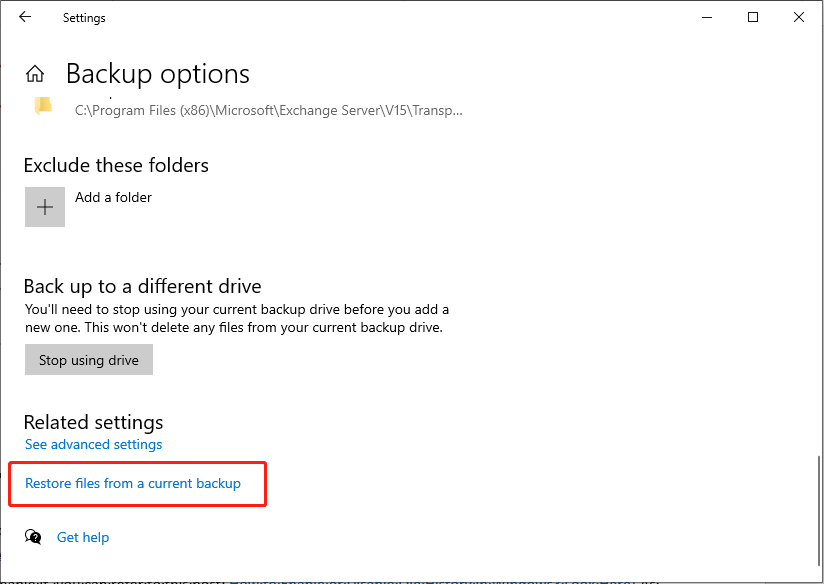
Step 3. In the following window, scroll down to find and click the Restore files from a current backup link to enter the File History backups window.
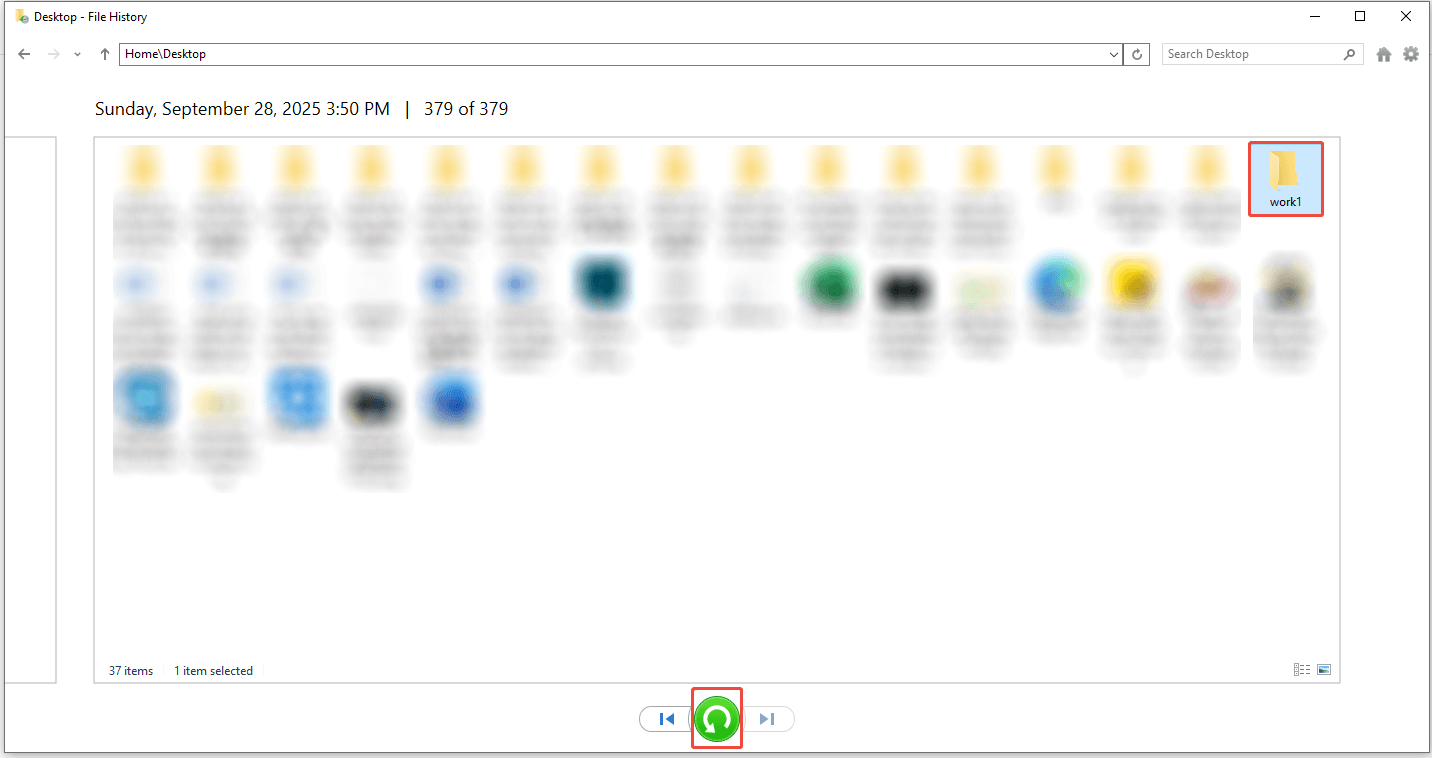
Step 4. Choose the folder you want to restore, and then click the green “Restore” button. Then you can go to the folder’s original location to check whether it is back.
In addition to File History, Windows also provides a feature called Previous Version. You can also give it a shot.
Method 4. Restore a Previous Version of the Folder
If you have accidentally lost or deleted multiple folders from the same location on your computer, the Previous Versions tool can help. This offers an alternative method to recover files and folders from your File History backups.
Using this tool, you can revert the entire parent folder to its state before the important folders were deleted – simply by recovering from your saved File History versions.
To restore a previous version of the deleted folder, follow these steps:
Step 1. Press Win + E to open File Explorer.
Step 2. Go to the folder where your deleted/lost subfolders are saved.
Step 3. Right-click and choose Restore previous versions from the menu.
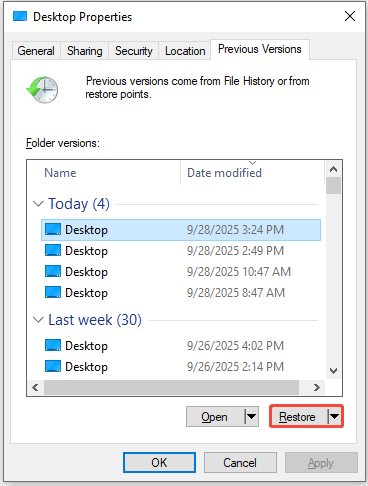
Step 4. From the list provided by Windows, select the version you want to recover. Click the Restore button to bring back your folder.
When the pop-up window asks, “Are you sure you want to restore the previous version of…”, click Restore again to confirm the action.
Moreover, you can also check your cloud backups if you have created them.
Method 5. Check the Cloud Backup
For cloud services like OneDrive, Google Drive, or Dropbox, you can simply log into your account and search for your backups to recover folders.
If you do not have a cloud backup, what should you do to rescue your folders? In this case, is there another way to restore lost folders? Keep reading for the last resort.
Method 6. Use Powerful Data Recovery Software
If you’re unable to recover folders from File History backup or cloud services in Windows, the do-it-yourself software can quickly help you rescue your folders.
MiniTool Power Data Recovery is a robust and reliable data recovery tool specifically designed for deleted folder recovery.
Here are some major features to show you why this free data recovery software is trustworthy.
Key Features of MiniTool Power Data Recovery:
- File and Folder Recovery: MiniTool Power Data Recovery is capable of restoring a wide range of files and folders, making it beneficial for different recovery situations. It can retrieve photos, documents, videos, audio, and more.
- Support for Various Data Loss Situations: It is highly effective in addressing multiple data loss circumstances, such as folders deleted using the Shift + Delete shortcut or command lines, data losses caused by file system errors, and even when the disk is identified as RAW or unallocated.
- Recovery from Multiple Devices: The software can retrieve data from an array of storage devices, including hard drives, SSDs, memory cards, cameras, camcorders, and beyond.
- Preview Before Recovery: You can view files before recovery, which allows you to confirm the files’ integrity and content. This function helps ensure that you are restoring the correct files and folders.
- User-Friendly Interface: MiniTool Power Data Recovery features an intuitive interface that even users with minimal technical skills can use it efficiently for file recovery.
Now, let’s start folder recovery using MiniTool Power Data Recovery:
Step 1. Click the download button below to download and install MiniTool Power Data Recovery Free on your computer. This edition supports recovering 1 GB of files for free.
MiniTool Power Data Recovery FreeClick to Download100%Clean & Safe
Step 2. Open this tool. In this concise window, you can see a This PC interface with three sections:
- Logical Drives: This module displays all detected partitions of internal disks and external devices.
- Devices: Click the Devices tab, and you will see the entire disks connected to your computer.
- Recover From Specific Location: This section provides you with three quick scan and recovery options, including the Desktop, the Recycle Bin, and a specific folder.
Click the target partition/device where your folders were lost and click Scan. Here I select the desktop to scan.

Wait patiently until the process finishes to get the best results.
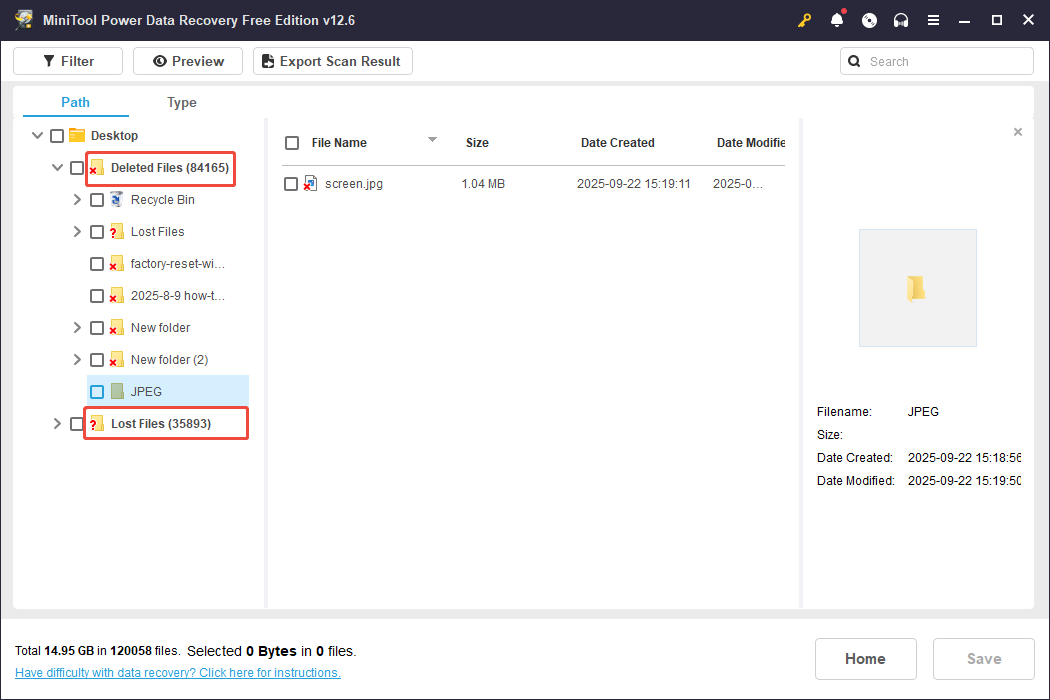
Step 3. After scanning, you can directly expand each folder (the Lost Files or Deleted Files folder) under Path to find the folders you want to recover.
If there are piles of files in the result lists, you can use some functions to swiftly locate folders:
- Filter: Click the Filter button to refine your file search by file type, file size, date modified, and file category.
- Search: Located in the top right corner, the Search function allows you to quickly find files or folders by typing keywords in the search bar and pressing Enter.
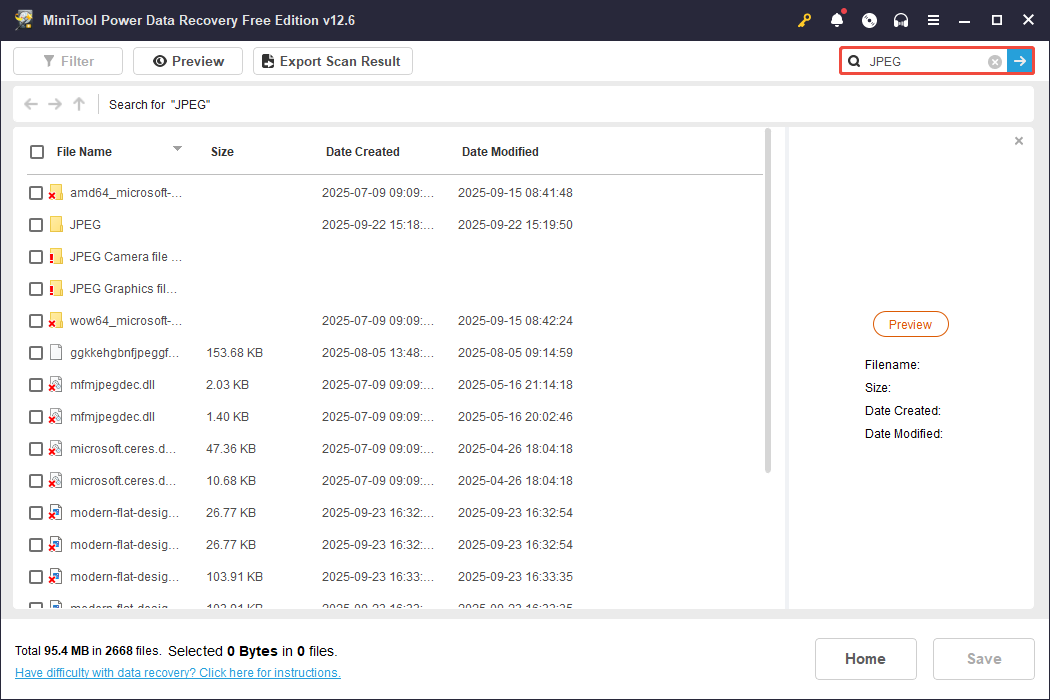
Once you locate the desired folder, you can open it, select the files, and click the Preview button to check whether the folder is what you want.
This function allows you to preview audio files, photos, and videos.

Step 4. Finally, click the Save button, and then choose a safe file location to store the recovered files. Be aware that you should not save the recovered files to their original location in case of data overwriting.
If you see a prompt to upgrade the software to retrieve additional files, it means that the 1 GB of free file recovery space has been exhausted.
In this situation, you will need to upgrade to the full version to recover the remaining files. Here, you may be interested in the MiniTool Power Data Recovery License Comparison.
After Recovering: How to Prevent Folder Loss in the Future?
While you’re diligently trying to recover deleted/lost folders, it’s wise to consider ways to prevent similar issues in the future. Here are some suggestions:
- Be Cautious: Exercise caution when deleting folders or formatting drives. Always verify before performing any action that could lead to data loss.
- Regular Backups: Make it a routine to back up your files and folders consistently. Utilize cloud services or external hard drives to store copies of crucial data.
- Backup Software: Consider acquiring dependable backup software that can handle the process automatically for you. MiniTool ShadowMaker is worth considering.
MiniTool ShadowMaker TrialClick to Download100%Clean & Safe
To back up folders using MiniTool ShadowMaker, follow the breakdown:
Step 1. Open the backup tool and hit Keep Trial to continue.
Step 2. Once you reach the home page, navigate to the Backup section in the left menu.
Step 3. In the SOURCE section, click Folders and Files to select the folders/files you want to back up, or click Disk and Partitions to select the partition/disk to back up. Next, select a safe location to store the backup files from the DESTINATION section.
Step 4. Finally, click the Back Up Now button to start the backup process.


Final Words
This post provides six methods on how to recover deleted folders on Windows. Check the Recycle Bin and backups first. If they do not work, use MiniTool Power Data Recovery to get your folders back. Once the folders are restored, take some precautionary measures to protect your data.
We extend our best wishes for the successful restoration of your folders. If you have any questions about MiniTool Power Data Recovery, you can send emails to [email protected].
User Comments :