
When the Users folder is missing, it does not necessarily mean the folder has been deleted. Follow this MiniTool guide to make it visible by restarting the computer or showing hidden files. If the user profile folder is not showing up in Users, try executing the Attrib command or creating a new account to fix the problem.
Quick Answer:
The Users folder is rarely deleted. If it is missing from the C: drive, it is usually hidden due to system settings or file attributes. You can restore visibility by restarting the computer, enabling hidden items, using the Attrib command, or performing System Restore.
Users Folder Missing in Windows
The Users folder is a core Windows directory on the C drive that stores each user profile data, including Desktop, Pictures, and Documents.
If the Users folder seems to be missing from the C drive, it is typically still present as long as Windows boots correctly. As a protected system directory, it cannot normally be deleted.
Why the Users Folder May Appear Missing
The Users folder may be hidden or inaccessible due to the following causes:
| Cause | Explanation |
| Hidden system attribute | The Users folder is marked as hidden/system |
| File Explorer settings | Hidden items disabled |
| Temporary system glitch | File Explorer display errors |
To confirm that the Users folder still exists:
Step 1. Press the Windows + R key combination to open the Run dialog.
Step 2. Type %appdata% in the box and press Enter to open the AppData\Roaming folder for the current user.
Step 3. In the File Explorer window that opens, click the address bar, and you will see that the Users folder is part of the full path.
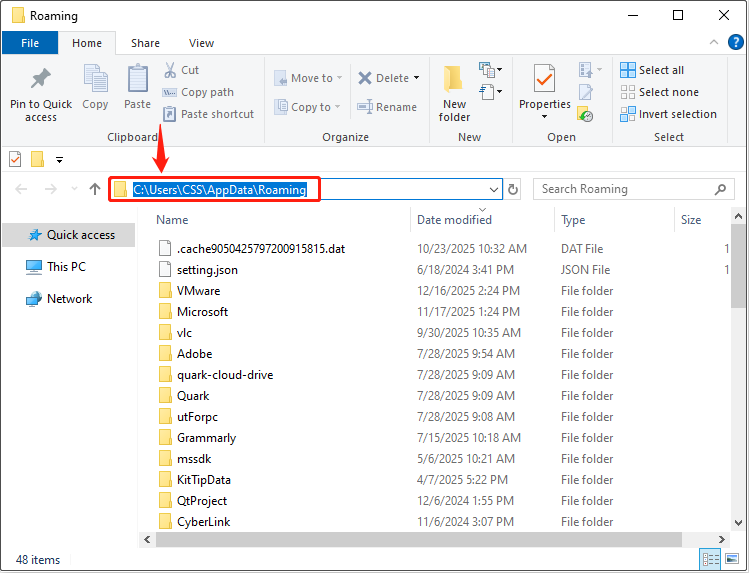
This confirms that the Users folder still exists and is simply not visible for certain reasons. Follow the instructions below to unhide the Users folder.
Case 1. How to Fix Missing Users Folder
To resolve the “Users folder disappeared” issue, begin by restarting the computer to eliminate temporary system glitches. Next, adjust the system settings to show hidden files.
If the problem persists, consider performing a system restore to determine whether potential system issues are causing the folder to disappear.
Solution 1. Restart the Computer
When the Users folder is not showing in the C drive, a simple system restart may resolve the issue. Rebooting the PC can:
- Clear temporary memory
- Reset background processes
- Reload system files
- Fix temporary system glitches
To restart your computer, click the Windows logo button > Power > Restart.
After restarting the computer, open the C drive and check if the Users folder appears correctly. If the folder still does not appear, proceed to the next method.
Solution 2. Show Hidden Files
The Users folder is not hidden by default. However, it may become hidden due to user actions, malware infection, or other system-related factors.
To make it show up again, enable the hidden files feature:
In File Explorer, go to the View tab on the Ribbon and check the Hidden items box.
All hidden files on your computer will become visible, and they will appear with a slightly transparent icon to distinguish them from regular files.
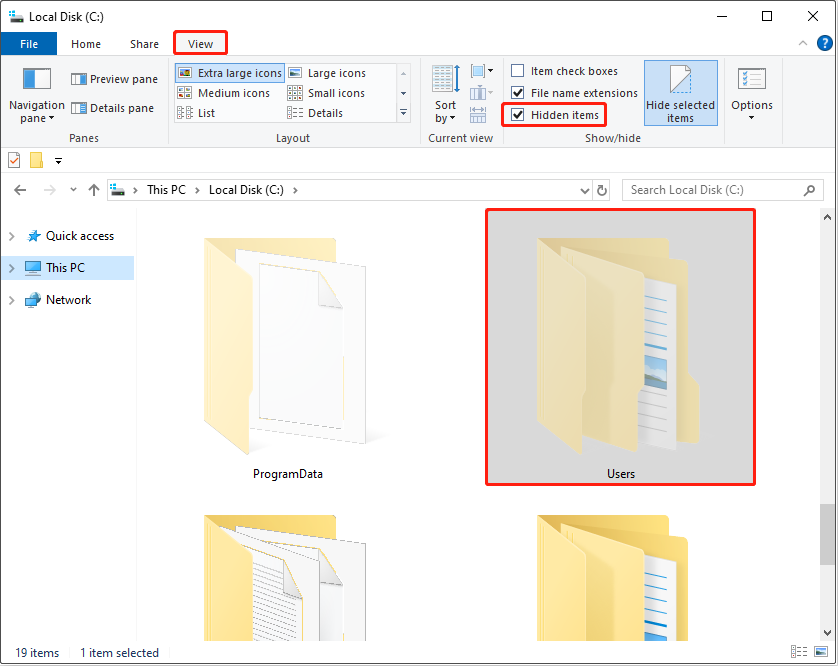
To unhide the Users folder, right-click it and choose Properties. In the new window, uncheck the Hidden option, and click OK to confirm.
Read More:
If the Users folder does not appear after adjusting File Explorer options, use the Attrib command to remove hidden, read-only, and system attributes from files and folders on the C: drive, which may restore folder visibility.
Here are the steps:
Step 1. Run Command Prompt as an administrator.
Step 2. Type attrib -h -r -s /s /d C:\*.* and press Enter.
- attrib: A built-in Windows command used to view or modify file attributes
- -h: Removes the “hidden” attribute
- -r: Removes the “read-only” attribute
- -s: Removes the “system” attribute
- /s: Processes all files in the current directory and all subdirectories recursively
- /d: Also applies changes to directories themselves (not only files)
- C:\*.*: Targets all files in the C: drive (all file types and all files)
Once it is completed, the Users folder should appear.
Solution 3. Perform a System Restore
If none of the above solutions fix the problem, the system itself may be experiencing errors. In this case, try performing a system restore to return Windows to a point before the issue occurred.
Here is how to do a system restore:
Step 1. In the Windows search box, type Create a system restore point. Then select the best match result to open the System Properties window.
Step 2. Click System Restore. In the new window, review the information provided and click Next.
Step 3. Select a restore point and click Next. Then follow the on-screen instructions to complete the restore process.
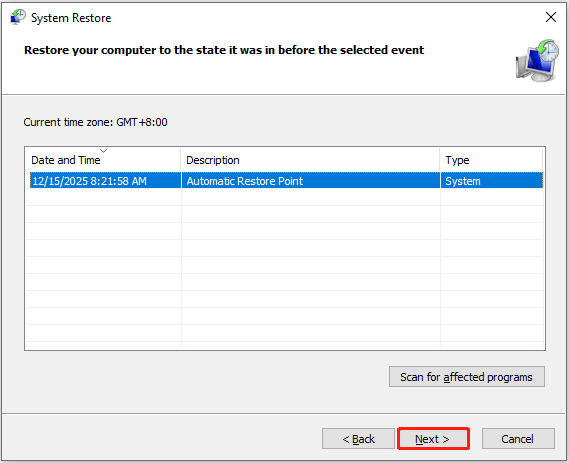
In most cases, the methods outlined above can restore the visibility of the Users folder. In the next section, we will walk through the steps to fix another issue: the username folder not showing up in Users.

Case 2. How to Fix Missing User Profile Folder in Users
In the Users folder, you should normally see several subfolders, including your username, Public, and Default. However, in some cases, the folder associated with your username may not appear.
When this happens, try unhiding the folder or creating a new user account.
If you notice that some files are missing, check the Recycle Bin or use data recovery software to attempt recovery.
Method 1. Try Some Basic Checks
To rule out minor glitches, try the following basic troubleshooting steps:
- Restart Windows Explorer.
- Restart the computer.
- Open File Explorer, click View in Ribbon, and check Hidden items.
If the folder is still not showing up, proceed with the following methods.
Method 2. Use the Attrib Command
The Attrib command is used to remove hidden and read‑only attributes from files and folders. Follow the steps below to use it to restore the visibility of your user profile folder.
Step 1. In File Explorer, type %userprofile% in the address bar and press Enter.
Step 2. If the correct location shows up, open Command Prompt as an administrator.
Step 3. Type attrib -h -r -s /s /d “C:\Users\YourUserName” and press Enter. Replace YourUserName with the actual username.
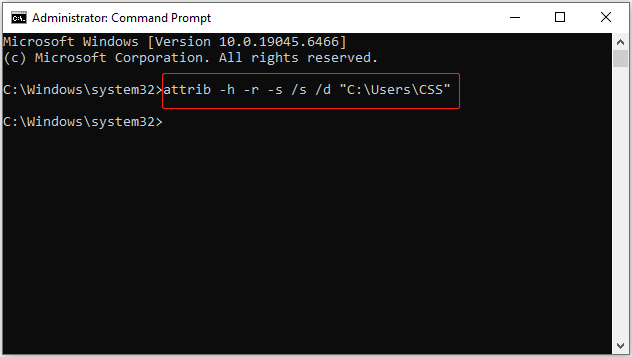
After executing this command, open the Users folder and check if the profile folder is showing up.
Method 3. Create a New Account
Sometimes the account folder may still be missing, even though you can access the Desktop and other subfolders within the user profile.
In this situation, you may consider creating a new user account and then transferring the files from the missing profile to the new one.
Access all files associated with the old account by using the full path or the Run dialog, and back them up. After that, follow the steps below to create a new local account:
Step 1. Press Windows + I to open Settings.
Step 2. Click Accounts.
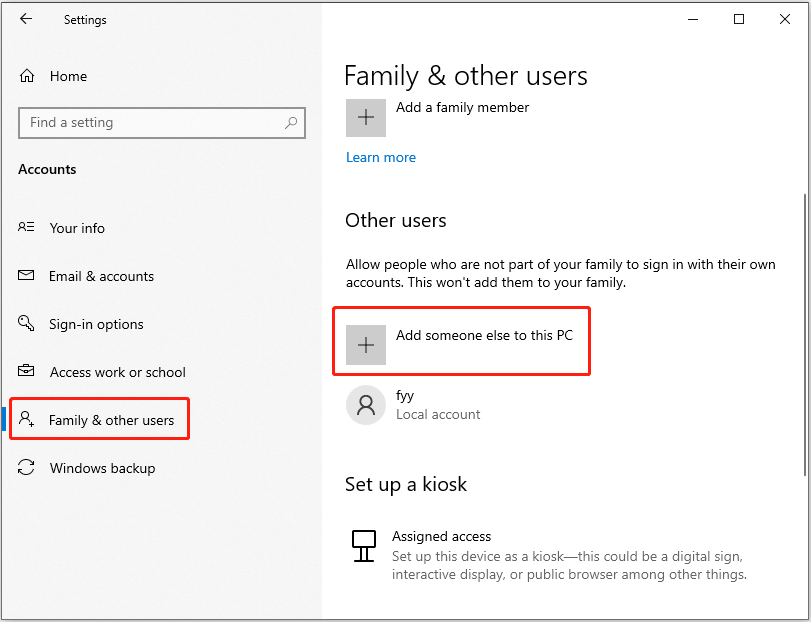
Step 3. Click Family & other users. Under Other users, click Add someone else to this PC.
Step 4. Choose I don’t have this person’s sign-in information.
Step 5. Choose Add a user without a Microsoft account.
Step 6. Set up the username and password, and then click Next.
Step 7. Log in to your computer with the new account, and then copy and paste the files from your old account.

Method 4. Check the Recycle Bin for Lost Files
If your user profile folder reappears but some files inside are missing, check the Recycle Bin first to see whether they are there. If they are, select the files, right‑click them, and choose Restore. They will be returned to their original locations.
Alternatively, you can drag and drop the target files to any preferred location on your computer.
If the files are not in the Recycle Bin or anywhere else on your system, they may have been lost. In this case, you will need to use data recovery software to restore them.
Method 5. Recover Lost Files With Data Recovery Software
To recover deleted files, use MiniTool Power Data Recovery, the best free data recovery software.
This software stands out for its wide support of file types, file systems, and storage devices. The table below summarizes its key capabilities.
| Supported file types | Photos, videos, documents, audio files, emails, archives |
| Supported storage media | Internal/external hard drives, USB flash drives, SD cards, and other storage devices |
| Supported file systems | NTFS, FAT32, exFAT, RAW |
| Supported Windows versions | Windows 11/10/8/8.1 |
| Supported recovery scenarios | Accidental deletion, drive formatting, disk errors, system crash, virus attack |
| Free recovery capacity | 1 GB of free data recovery quota |
Now, download this file restore tool and use it to recover files.
MiniTool Power Data Recovery FreeClick to Download100%Clean & Safe
Step 1. Select the location or folder to scan.
Under the Logical Drives section of the recovery software, select the drive that contains the files from your user profile folder (usually the C drive) and click Scan.
Alternatively, click Select Folder and then choose the specific folder to scan. This usually saves the scanning time.

Step 2. Find and preview target files.
After the scan completes, browse the results under the Path or Type tab. Path displays files based on their original folder structure, while Type groups files by file type and format.
The software also provides the Filter and Search features to help you locate files more efficiently.
Click Filter to narrow down results by file type, modification date, file size, and file category. To search for a file directly, enter a partial or full file name in the search box and press Enter.
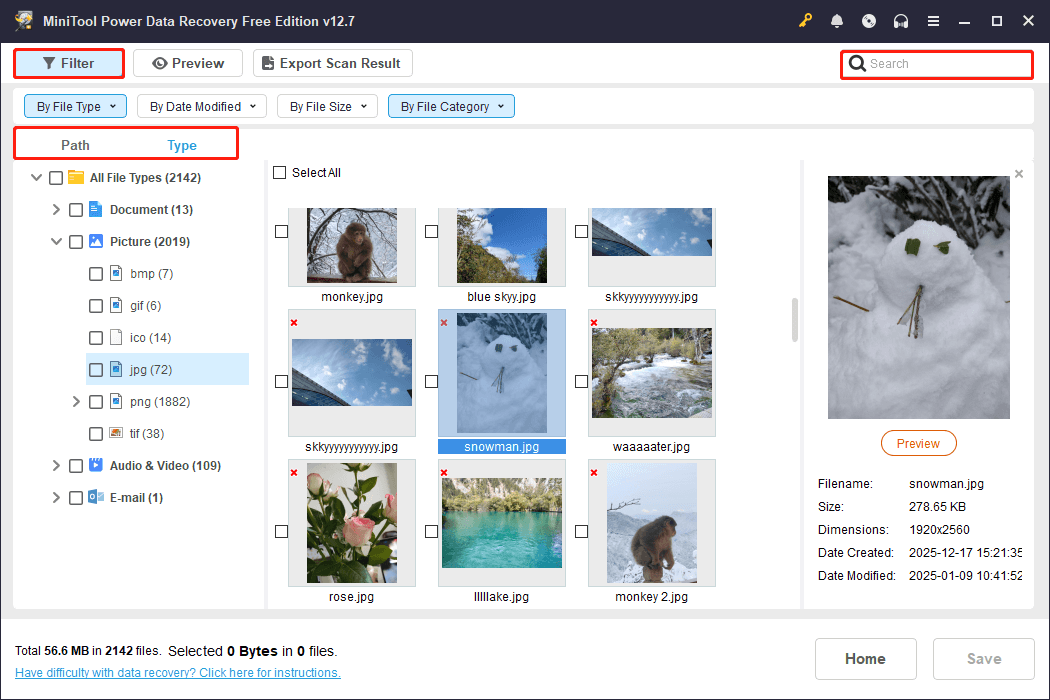
When you find a file you want to recover, double‑click it to preview its content. The Preview feature supports images, videos, documents, audio files, emails, and various other formats.
Step 3. Save the required files.
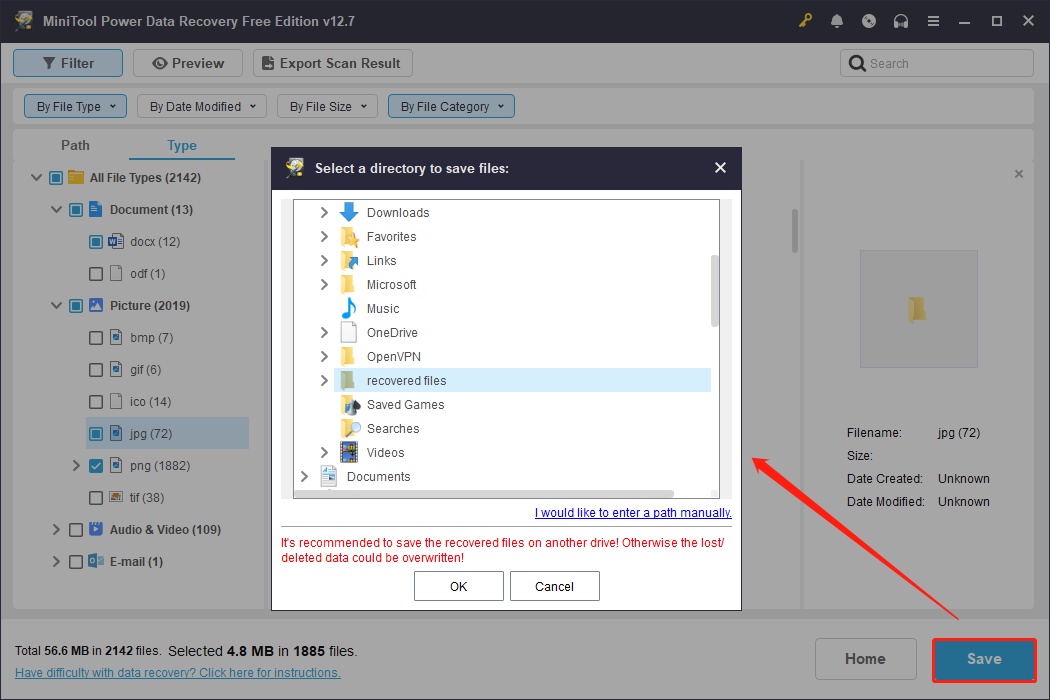
Review the selected items and ensure all files you want to recover are checked to avoid secondary scanning. Then click Save.
In the pop‑up window, choose a destination to store the recovered files. Avoid saving them to their original location, as this may overwrite existing data. Overwritten files cannot be recovered by any data recovery software.
Bottom Line
To sum up, if the Users folder is missing, try restarting your PC, enabling the option to show hidden files, or performing a system restore.
If the account folder is missing in the Users folder, run the Attrib command to display it or create a new account.
If some of your files are lost from the Users folder, check the Recycle Bin or use data recovery software to restore them.
Should you encounter any issues while using the MiniTool data restore tool, please contact the technical support team at [email protected].
Users Folder Is Missing FAQ
For hidden files, go to the View tab in File Explorer and check the Hidden items option.
For deleted files, try pressing Ctrl + Z to undo the deletion, checking the Recycle Bin, restoring from backups, or using data recovery software.
If it is a system folder, try running System Restore to revert Windows to a previous state.
Then the Users folder should appear semi-transparent. To fully unhide it, right-click it and choose Properties, and uncheck the Hidden attribute.
Alternatively, you can open Command Prompt as an administrator and execute attrib -h -r -s /s /d C:\*.*. This command removes hidden, read-only, and system attributes of the files on the C drive, including the Users folder.
The hidden attribute was enabled
Accidental deletion
Moved to another location
Only a shortcut was removed, not the actual folder
System errors or malware affecting visibility
Disk or profile issues after updates or crashes
About The Author

Position: Columnist
Shirley holds a bachelor’s degree in English and has been an editor at the MiniTool Team for many years. She specializes in IT-related content, with a focus on data recovery, file backup, disk management, and other technical topics. She is committed to delivering clear, accurate, and practical solutions to help users resolve common computer issues.
User Comments :