
An HP BIOS update is used to fix firmware bugs and improve hardware compatibility. This guide explains when to update your HP PC BIOS, how to check the current BIOS version, and how to complete the update in Windows 11/10 through 4 safe methods.
Quick Answer
In some cases, an HP BIOS update can help resolve some hardware compatibility, stability, or security issues. Before updating, check the BIOS version and back up important files to prevent data loss.
Then, follow one of the methods below to update your HP BIOS safely in Windows 11/10.
- Use HP Support Assistant
- Manual Update from HP Website
- Update BIOS via BIOS/UEFI Setup
- Use a USB Drive
What Is HP BIOS Update
The BIOS is essential firmware located on the motherboard that initializes the computer. It also facilitates communication between the operating system and hardware components such as the CPU, RAM, and storage devices.
An HP BIOS update is a firmware upgrade for HP laptops/desktops to improve system stability, compatibility, and security.
When to Update HP BIOS
Updating your HP BIOS is not a routine task like updating Windows or an app. Because a failed update can render your motherboard unusable, you should only update under specific circumstances.
# 1. Specific HP Recommendations
If HP Support Assistant marks a BIOS update as “Critical”, it is generally recommended to install it. Additionally, if the BIOS update resolves a known issue particularly for your model, it is recommended to install the update.
# 2. Persistent Bugs
Consider updating BIOS when you experience persistent bugs, such as:
- Systematic crashes
- Hardware malfunctions, like Wi-Fi drops or USB ports not working
# 3. Hardware Upgrades
Upgrading your computer’s CPU, RAM, or hard drive may require a BIOS update. This update helps your motherboard recognize and support newer hardware. It ensures your system works correctly with newer hardware released later.
# 4. Newer Features
The update brings improved performance, better power management, and new, necessary features.
How to Check Your Current HP BIOS Version
Checking the BIOS version can help decide whether a BIOS update is required and prevent you from downloading the wrong version.
Method 1. Within Windows (Easiest)
If your HP computer can boot normally, the following guides are suitable for you:
Option 1. System Information (msinfo32)
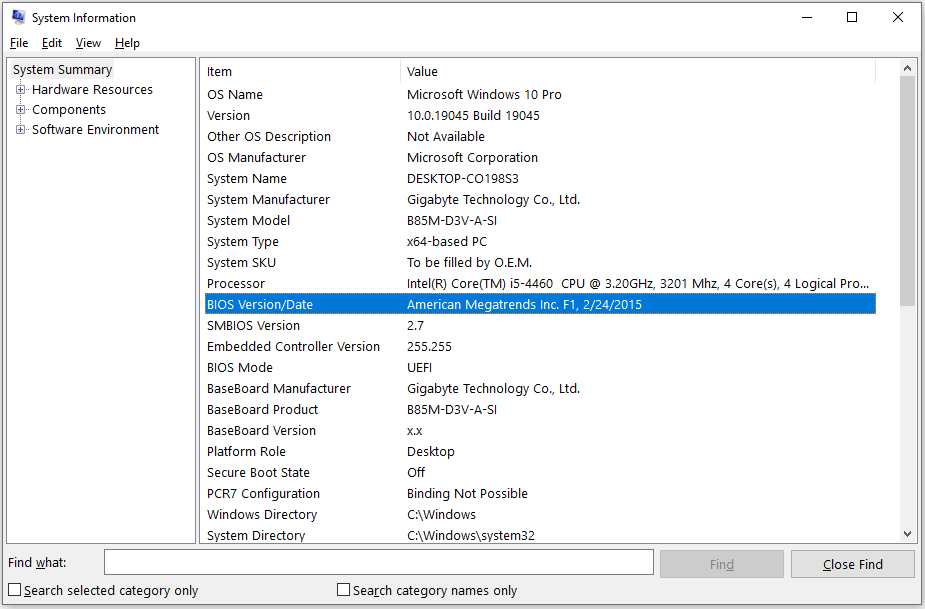
Microsoft System Information (Msinfo32.exe) is a Windows utility that collects detailed information about hardware, system components, and software.
It offers a comprehensive overview for diagnosing issues, including BIOS, memory, and driver details. Here are the steps to view the BIOS version from it.
- Press Win + R in Windows 11/10 to open Run.
- Type msinfo32 and press Enter
- Locate BIOS Version/Date in the System Summary pane.
Option 2. Command Prompt
Windows Command Prompt is a text-based tool for controlling your computer. It allows you to run scripts, automate tasks, and fix system issues.
It offers more direct control over the operating system than using standard icons and menus. Here’s the guide:
- Open Windows 11/10 Search.
- Type cmd in the search box.
- Find Command Prompt from the result.
- Right-click it and select Run as administrator.
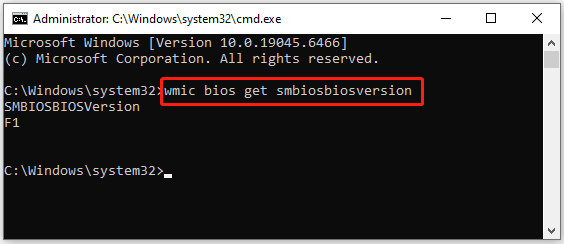
- Type wmic bios get smbiosbiosversion and press Enter.
- Now, the BIOS version shows up.
Option 3. HP Support Assistant
HP Support Assistant (HPSA) is a preinstalled Windows utility that simplifies the process of checking and updating the BIOS.
It analyzes system hardware, identifies the current BIOS version, and lists available updates.
- Open Search.
- Search for and open the HP SupportAssistant app.
- On the My devices or My notebook tab, select Updates.
- It will not only display your current version but also the latest available BIOS version.
Method 2. During Startup (BIOS Menu)
In addition to checking BIOS version within Windows, it is also possible to check it during startup via the BIOS menu. This method is recommended when unable to enter Windows.
- Turn off the computer.
- Turn it back on and immediately start tapping the F10 key until the BIOS setup utility appears.
- Look for the BlOS version or date under the “Main” or “System Information” tab.
Before Updating the HP BIOS
Updating BIOS is generally safe if you follow the instructions carefully. However, if the update is interrupted or fails, your computer may not boot properly.
Before proceeding, prepare the Windows 11/10 PC to minimize the risk of update failures.
- Keep your laptop plugged into AC power or ensure your desktop has a stable power supply.
- Close all the Apps and disable the antivirus program.
- Suspend BitLocker encryption to prevent the system from triggering a recovery prompt.
- Verify the HP product model and download the correct BIOS version.
- Back up important files to avoid data loss caused by unexpected issues during the update process.
Back Up Data with MiniTool ShadowMaker
Always back up your data before updating your BIOS to prevent permanent loss.
A failed update can brick your motherboard, making your computer unbootable and data recovery much more difficult.
Having a backup ensures your files stay safe if the system crashes or becomes corrupted during the process.
To back up data, it is highly recommended to use MiniTool ShadowMaker. This Windows backup software offers the Backup feature to perform file backup and system backup with ease.
Here’s how to use this software to back up important data in Windows 10/11:
Step 1. Download and install MiniTool ShadowMaker on your computer.
MiniTool ShadowMaker TrialClick to Download100%Clean & Safe
Step 2. Launch this software to enter the main interface and select Backup.
Step 3. Choose SOURCE and select Folders and Files.
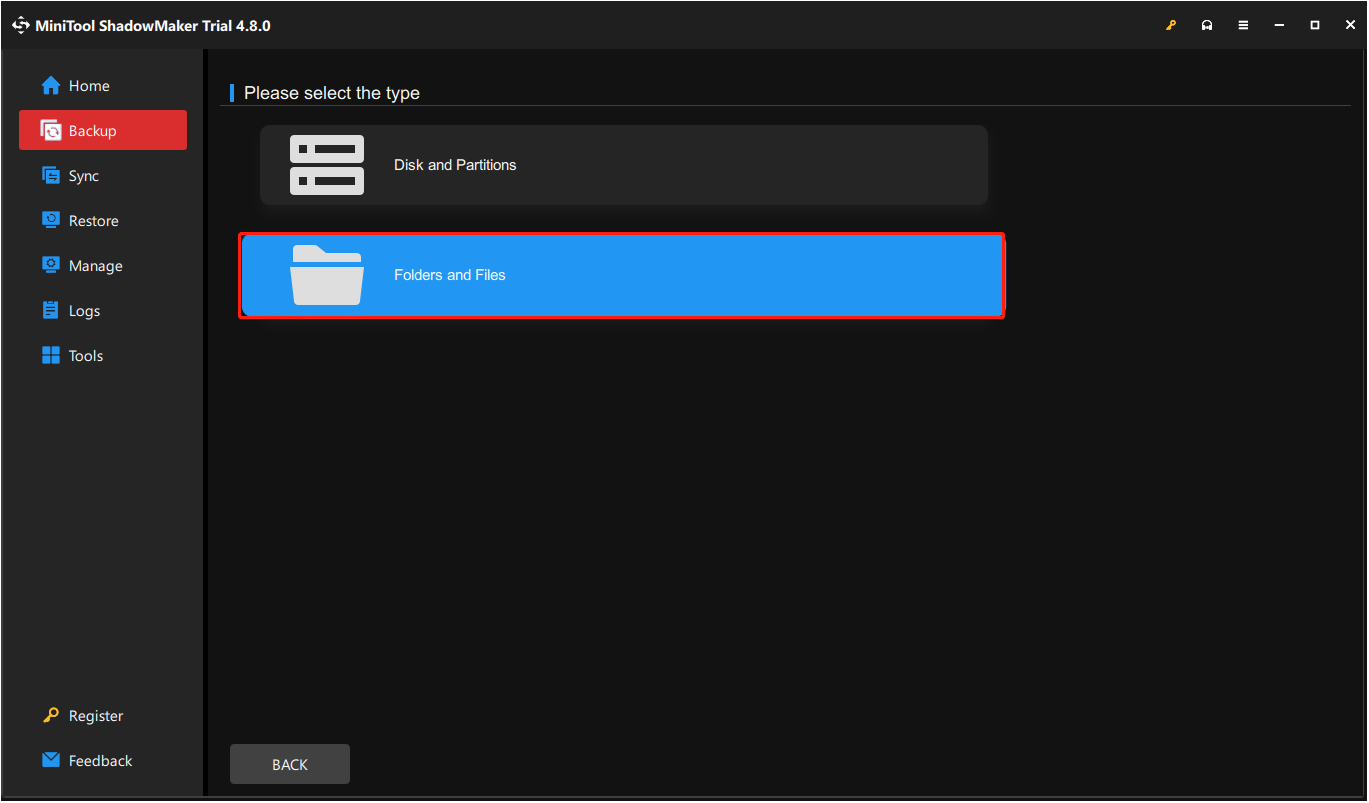
Step 4. Select the files that you want to back up and click OK.
Step 5. Enter the DESTINATION section, choose a target location to save the backup files, and click OK to proceed.
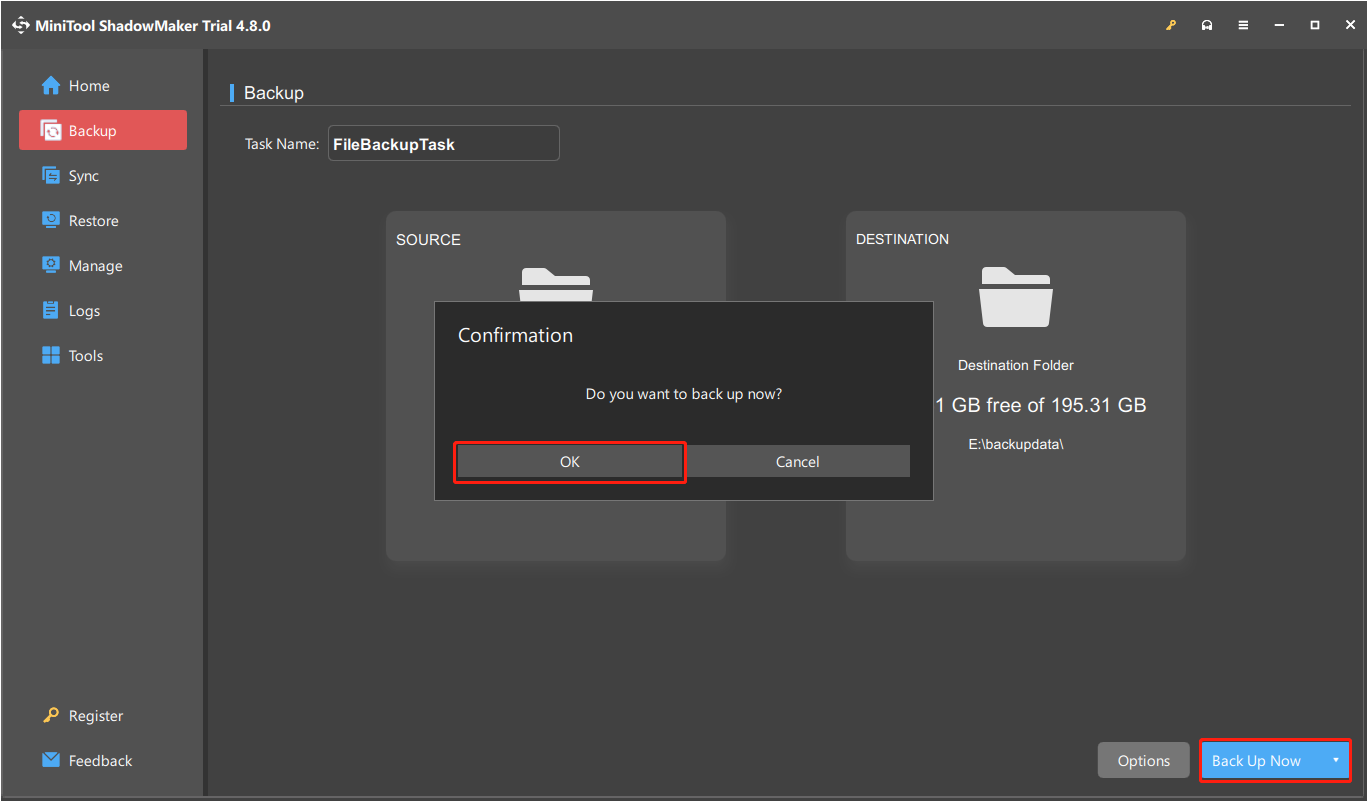
Step 6. Click Back Up Now and OK sequentially to confirm.
How to Update HP BIOS in Windows 11/10
HP provides 4 methods to update the BIOS. Choose the one that best fits your situation.
| Situation | Recommended Method |
| Windows starts normally, and you want the easiest method for an HP BIOS update. | Use HP Support Assistant |
| HP Support Assistant cannot detect an update, or you prefer a manual installation. | Update from the HP Support website |
| Your HP PC supports updating the BIOS directly from the BIOS menu. | Via BIOS Setup Utility |
| Windows 11/10 won’t boot. | Use a USB drive |
Approach 1. Use HP Support Assistant
Best for: Most users who can boot into Windows 11/10 and seek the easiest, safest update method.
HP Support Assistant not only checks the BIOS version but also helps update it. It automatically identifies the correct, compatible version for your system.
- Open HP Support Assistant from the Start menu.
- Go to the My devices tab and click Check for updates and messages.
- If a BIOS update is listed, select it and click Download and install.
- Follow the on-screen instructions to complete the process.
Approach 2. Manual Update from HP Website
Best for: Users who want to update the BIOS manually, or situations where HP Support Assistant fails to detect a BIOS update.
HP offers the latest drivers and software on its official website. Therefore, it is also possible to manually update the HP BIOS from the HP website. To do that, please follow the steps below:
Step 1. Visit the HP Software and Driver Downloads page. Then, identify your product.
Step 2. Expand the BIOS category and download the latest HP BIOS update.
Step 3. Close all open apps and double-click the downloaded .exe file to start the installer.
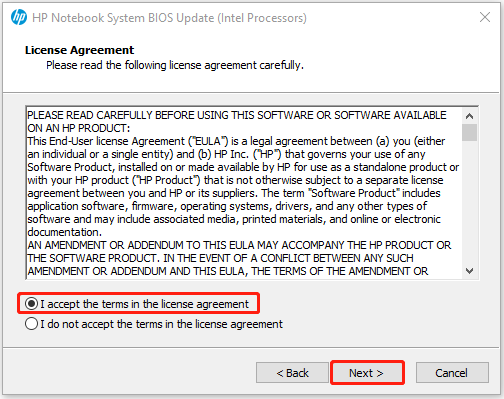
Step 4. Click Next and accept the terms in the license agreement.
Step 5. Choose a proper location and click Next. Then, click Next in the prompted HP BIOS Update and Recovery window.
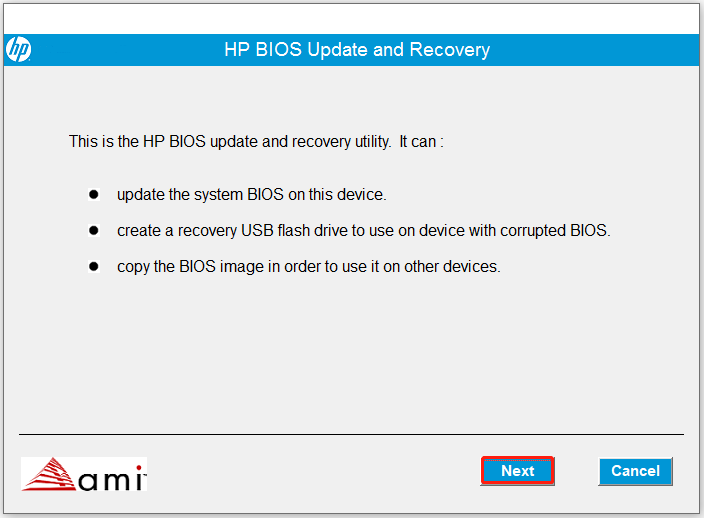
Step 6. Select Update and click Next to prepare the update. Then, click Restart Now after the BIOS update is prepared successfully.
Step 7. Choose Apply Update Now. Then, the installation will take a few minutes to complete.
Step 8. After finishing the update, click Continue Startup.
Step 9. Next, log in to your HP computer, resume BitLocker protection, and re-enable your antivirus programs.

Approach 3. Via BIOS/UEFI Setup (F10)
Best for: Supported HP computers that allow BIOS updates directly from the BIOS setup interface.
It is possible to update the HP BIOS via BIOS/UEFI setup as well. Here’s how to perform that:
Step 1. Plug the HP laptop/desktop into a reliable power source and ensure you have an active internet connection (if updating via network).
Step 2. Turn on the computer and immediately press the F10 key repeatedly until the BIOS setup utility screen appears.
Step 3. Choose Check HP.com for BIOS Updates.
Step 4. Click Continue or OK to start the update process.
Step 5. Do not turn off or restart the computer during the update, which may take a few minutes. The system will restart automatically once finished.
Approach 4. Update BIOS with a USB Drive
Best for: Computers that can’t boot into Windows 11/10.
Updating the BIOS via USB is primarily used for recovery and advanced scenarios, allowing you to flash the firmware without booting into Windows.
# 1. Getting the Computer BIOS Information
Step 1. Turn on the affected computer and press Esc repeatedly until the Startup Menu opens.
Step 2. Press the F1 key to open System Information.
Step 3. Write down the Product Name, SKU Number, System Board ID, BIOS Version/Revision, and Processor Type.
# 2. Prepare the Recovery USB Flash Drive
Step 1. On a working computer, download the BIOS update from HP Support.
Step 2. Plug in a USB drive and format it to FAT32. This is because the HP BIOS recovery tool typically doesn’t recognize exFAT or NTFS drives.
Step 3. Run the installer and click Next. Then, accept the License Agreement.
Step 4. Choose a location to save the files and click Next.
Step 5. Click Next in the pop-up window, and select Create Recovery USB flash drive. Then, click Next to proceed.
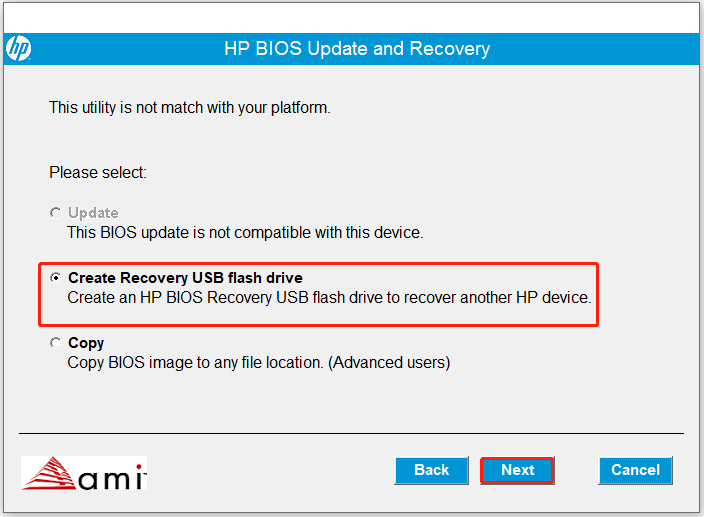
Step 6. Select your USB drive and follow the prompts to complete the process.
# 3. Use the Recovery USB Flash Drive to Update BIOS
Step 1. Insert the prepared USB into the original PC, power it on, and then follow the steps below according to your computer.
- Option 1 (If the computer has BIOS recovery): With the computer off, press and hold the Win + B at the same time. While holding, press and hold the power button for 2–3 seconds, then release everything. A BIOS update screen should appear.
- Option 2 (via Diagnostics): Turn on the computer and tap F2 repeatedly to enter HP PC Hardware Diagnostics UEFI. Select Firmware Management (or BIOS Management) > BIOS Update > Select BIOS Image to Apply > Select the file from your USB drive.
Step 2. Follow the on-screen instructions to complete the update. Do not turn off the computer during this process.
Final Words
If you want to know some information about the HP BIOS update, this post offers a step-by-step guide. Ensure you have backed up data with MiniTool ShadowMaker before updating the HP BIOS.
Moreover, if you have suggestions or encounter issues while using this MiniTool software, contact us via [email protected].
HP BIOS Update FAQ
If the update fails, the computer may not turn on. This can happen due to power loss, interruption, or using the wrong version. It is hard to fix, so BIOS updates should only be done when needed.
- You're experiencing instability issues when installing new hardware.
- You need important security patches.
About The Author

Position: Columnist
Vera has been working at the MiniTool Team for over 10 years as a technical editor and content writer. She mainly focuses on disk and partition management, data recovery, Windows backup and restore, and PC troubleshooting. Through in-depth software testing and hands-on experience, she has helped users solve a wide range of computer problems and better protect their data on Windows devices.
User Comments :