
What Is DISM Error 1009 Windows 10/11
DISM, also known as Deployment Image Servicing and Management, is an inbuilt command-line tool in Windows which allows you to prepare, modify and repair system images.
When running DISM commands, DISM error 1009 may occur. You may see one of the following error messages on the screen:
- Error 1009: The configuration registry database is corrupted.
- DISM error 1009 an initialization error occurred.
This usually indicates Windows cannot read or load a required system registry hive—most commonly the COMPONENTS registry hive.
DISM Error 1009 can happen for several reasons, including:
- Interrupted or incomplete updates can corrupt the registry database.
- File system errors or bad sectors can damage critical system files and registry hives.
- Corruption in the Windows component may prevent DISM from completing repair operations.
How to Fix DISM Error Code 1009 Windows 10/11?
It is recommended to create a bootable Windows installation USB drive before troubleshooting DISM Error 1009. This error involves a corrupted Windows configuration registry database, so repairing it from the running system may fail.
Fix 1: Revert Pending Windows Updates
If DISM Error 1009 appeared after a failed Windows update, revert pending update actions in the Windows Recovery Environment.
Step 1. Boot your PC using the created bootable USB drive.
Step 2. On the boot screen, press Shift + F10 at the same time to evoke Command Prompt.
Step 3. Type wmic logicaldisk get name in the command window and hit Enter to get a list of all the drives of your system.
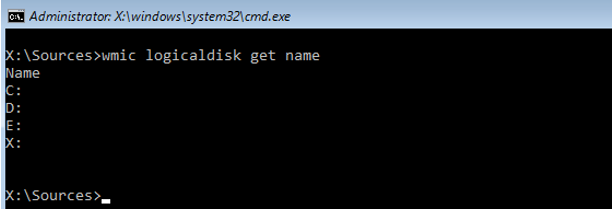
Step 4. If your Windows folder is in Drive D:, type dir D:. You can replace D with the drive which contains the Windows folder.
Step 5. Type D: again and tap on Enter.
Step 6. Copy & paste the following command to create a scratch folder in your drive and hit Enter.
mkdir D:\Scratch
Step 7. Now remove the recently installed updates by executing the following DISM command:
DISM /Image:D:\ /ScratchDir:D:\Scratch /Cleanup-Image /RevertPendingActions
Step 8. Exit Command Prompt and reboot your PC until you receive a message which informs you of the completion of this operation.
If your computer boot successfully, congratulations, you have solved DISM error 1009. If it fails to boot and even tries to install the updates again, you can follow these guidelines:
Step 1. Restart your computer using the installation media and launch Command Prompt again.
Step 2. Copy & paste the three commands one by one and hit Enter before running each command. Make sure to replace D: with the drive which contains the Windows folder.
del D:\Windows\SoftwareDistribution
del D:\Windows\WinSxS\cleanup.xml
del D:\Windows\WinSxS\pending.xml
Step 3. After executing these commands successfully, close Command Prompt and restart your computer again.
If you experience a boot failure again, don’t worry! There’s still a fix for you.
Step 1. Boot your computer a third time and open Command Prompt from Windows Recovery Environment.
Step 2. Run the following commands and don’t forget to replace D: with the right driver letter as mentioned in previous steps.
chkdsk /f D:
sfc /scannow /offbootdir=D:\ /offwindir=D:\windows
dism /image:D:\ /cleanup-image /restorehealth
Now, you will probably boot the computer successfully. If it still goes wrong, you can try the next fix.
Fix 2: Restore Registry from Backup
Restoring the Windows registry also helps to solve DISM error code 1009 Windows 10/11. Here’s what you should do:
Step 1. Enter Windows Recovery Environment and access Command Prompt.
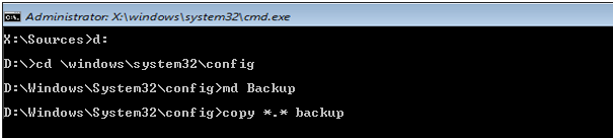
Step 2. Type D: and tap on Enter to open the Windows folder. (You should also replace D: with the corresponding drive letter.)
Step 3. Run these commands below one by one.
cd \windows\system32\config
md Backup
copy *.* Backup
Step 4. Locate the RegBack folder by running cd RegBack.
Check the file sizes before proceeding. If any of the files is 0 bytes, it means the registry backup is corrupted or empty, so stop the operation and restore Windows. If none of the files is 0 bytes, you can proceed with the following steps to restore the registry.
Step 5. Run the copy *.* .. command to copy the registry files to the Windows folder.
Step 6. Type A to overwrite the files in the destination.
Step 7. Once the file copying process is done, type exit and hit Enter to close Command Prompt.
Step 8. Restart your device.
If you boot the computer unsuccessfully, boot it again with installation media and launch Command Prompt to execute these commands one after another:
chkdsk /f D:
sfc /scannow /offbootdir=D:\ /offwindir=D:\windows
dism /image:D:\ /cleanup-image /restorehealth
Step 9. Reboot your PC and if still having trouble booting, please try the next solution.
Fix 3: Perform a System Restore
As mentioned in the fourth step in Fix 2, one condition is that you might notice some files with 0 bytes due to corrupt registry files. In this case, you need to perform a system restore to restore your Windows to an earlier version.
Step 1. Boot your system from the Windows installation media.
Step 2. If you see a page named Windows Setup, hit Next > Repair your computer > Troubleshoot.
Step 3. Under Advanced options, hit System Restore.
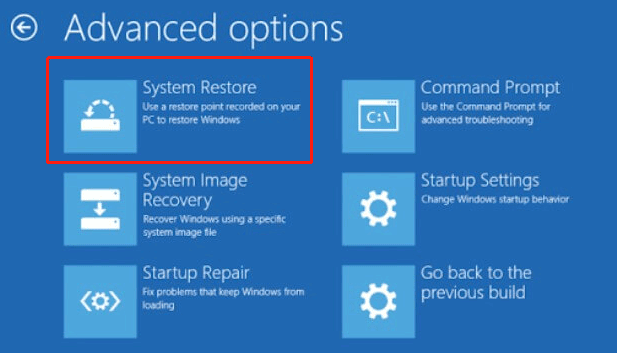
Step 4. Now, you can choose a target operating system. Select one and hit Next at System Restore Wizard.
Step 5. Select a restore point when your system was running normally.
Step 6. Tap Next to start the system restore process. When finishing this process, your system will restart automatically and then you can check if DISM error 1009 is gone.
What to do when System Restore failed? Don’t worry! Every problem has a fix. You can turn to this guide for help - System Restore Failed And Did Not Complete Successfully: 5 Fixes.
Fix 4: Perform an In-place Upgrade
An in-place upgrade helps replace damaged system hives to resolve DISM error code 1009 while keeping your personal files and apps.
To do so, you need to make some preparations:
- Log in with administrator rights.
- Disable all the third-party anti-virus software.
- Remove all the external devices except for the LAN cable, keyboard and mouse.
Step 1. Download Media Creation Tool.
Step 2. After downloading & installing it successfully, open this application and tick Upgrade this PC now.
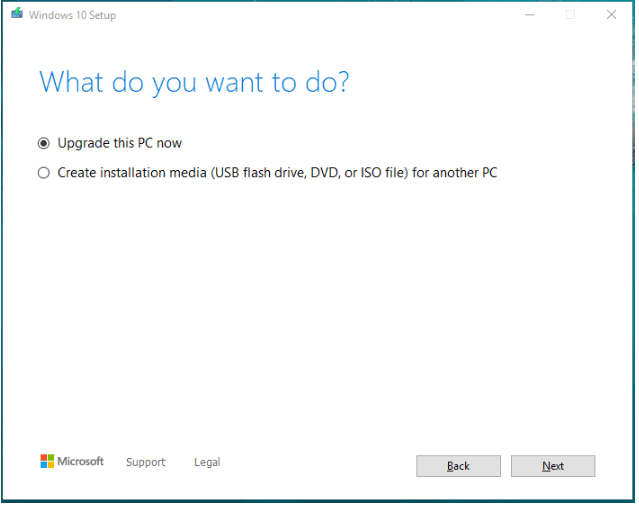
Step 3. Choose the Keep personal files and apps option if available in the Choose what to keep window.
Step 4. Follow the instructions on the screen to start the installation.
As soon as the in-place upgrade is done, the DISM error 1009 will disappear.
Fix 5: Reset Windows
If the previous methods fail, consider resetting Windows to fix error 1009. This can be used as a last resort.
Although Keep my files is designed to preserve personal files, some data may still be lost during a reset. Hence, backing up important files beforehand is recommended.
Back Up Files
To keep your data safe, a professional backup software, MiniTool ShadowMaker will be a good choice. It is specially designed to back up files, folders, systems, disks and partitions on Windows 11/10/8/7.
MiniTool ShadowMaker TrialClick to Download100%Clean & Safe
Now, you only need to do a few simple steps to back up your files:
Step 1: Launch MiniTool ShadowMaker and go to Backup.
Step 2: Navigate to SOURCE> Folders and Files and choose the source files.
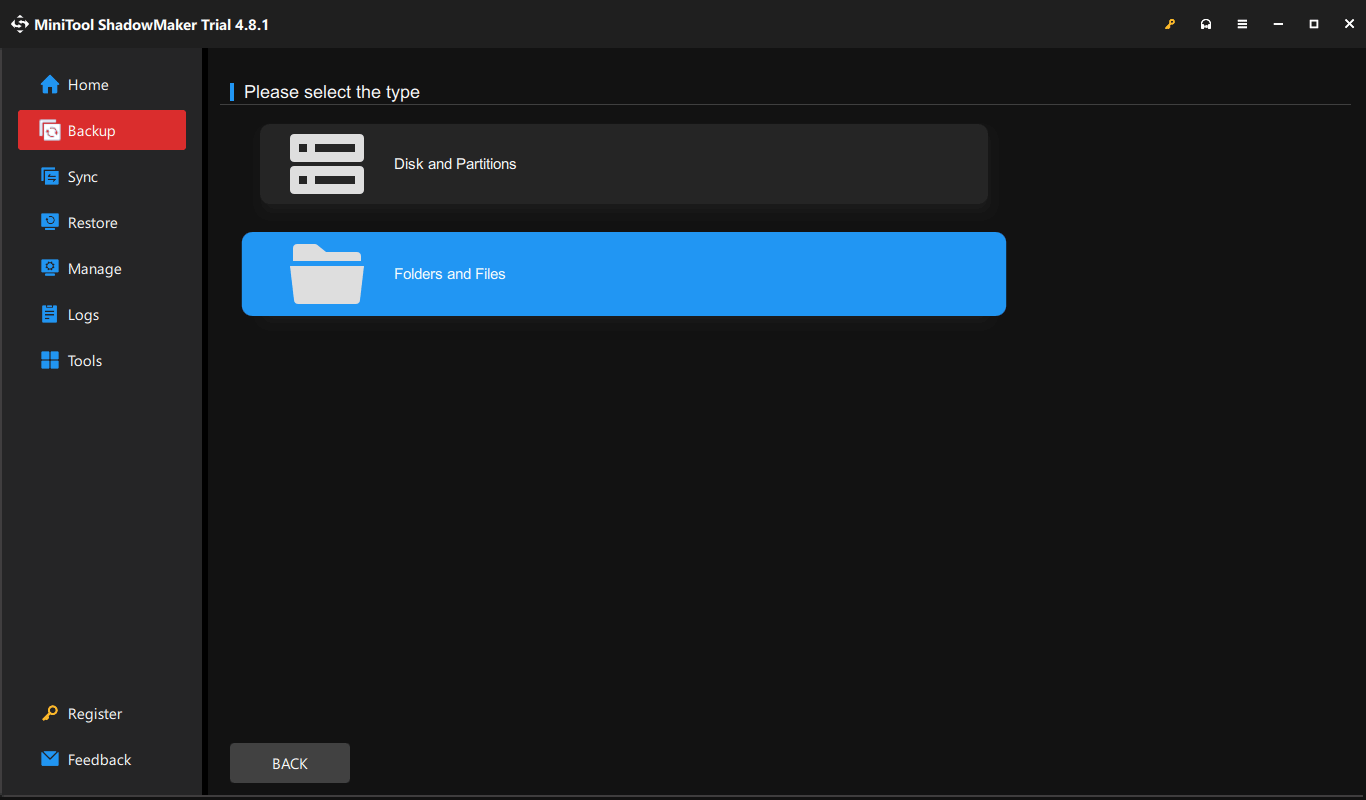
Step 3: Go to DESTINATION to select a drive.
Step 4: Click Back Up Now.
After the backup, resetting your Windows.
Reset PC
Step 1. Click on the gear icon to open Windows Settings.
Step 2. In the settings menu, scroll down to find Update & Security and tap on it.
Step 3. In the Recovery tab, hit Get started under Reset this PC.
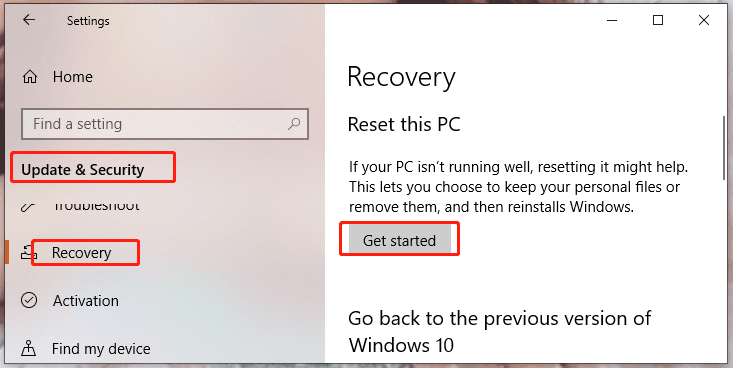
Step 4. In the new window, you should decide either to keep your files or remove them. Select Keep my files if you want to save your data.
Step 5. Now follow the guidelines on the screen to reset your Windows.
Step 6. If DISM error 1009 is still there, you can follow the steps above again and will have to choose Remove everything before resetting Windows.
Final Words
When encountering DISM Error 1009 in Windows 11/10, start with simple fixes, such as reverting pending updates, restoring the registry, or running System Restore. If these methods fail, consider an in-place upgrade or Windows reset.
Additionally, contact us at [email protected] if you have issues with our software during backup.
DISM Error 1009 FAQ
About The Author

Position: Columnist
Vera has been working at the MiniTool Team for over 10 years as a technical editor and content writer. She mainly focuses on disk and partition management, data recovery, Windows backup and restore, and PC troubleshooting. Through in-depth software testing and hands-on experience, she has helped users solve a wide range of computer problems and better protect their data on Windows devices.
User Comments :